22.11.06

Human Rights abuses in mining communities disquiet UN Commissioner

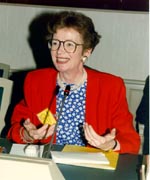
Ms Mary Robinson, Commissioner of UN Human Rights Commission, on Wednesday expressed concern about reports of human rights abuses perpetrated by mining companies in the country.
Speaking at meeting with advocacy groups in Accra hosted by Wassa Association of Communities Affected by Mining (WACAM) and Britain’s Oxfam, both nongovernmental organisations, Ms Robinson said she was deeply concerned by the information she had received regarding the range and severity of human rights problems that continued to affect the mining sector of the country.
“First of all, the level of compensation offered is manifestly unfair. To offer nine dollars to a farmer to buy out a cocoa tree worth at least 20 dollars per year over the tree's economic life of 30 to 50 years is not acceptable. “In a number of cases, security forces working around mine sites have used violent methods to displace community members from mining areas.
“In other cases, mining companies' destruction of communities' water and land resources constitute a violation of communities' right to maintain a sustainable livelihood,” she said. She observed that mining was now Ghana's most important economic sector and said if mining were to contribute to poverty reduction and sustainable development in the country, these critical human rights issues must be addressed.
Ms Robinson, who is a Former President of Ireland, urged the Government of Ghana, as a stakeholder in each mining company, to adopt and enforce regulations to protect the rights of communities in mining areas. “The Government should also thoroughly investigate complaints of human rights violations related to mining and hold those responsible accountable.” She said: “Mining companies must also act to ensure that they are in no way complicit in human rights violations.
At a minimum, this should include ensuring that they do not employ known human rights violators to provide security at mine sites. “They must also avoid contaminating the environment and negatively impacting the resources local communities depend on for their agriculturally-based livelihoods. “Companies should allow independent third-party audits of their compliance with these basic human rights principles.
They should also commit to establishing mechanisms for ongoing independent monitoring of their operations. Such mechanisms should include the participation of local community members, Ms Robinson said.
Representatives of WACAM; Oxfam; Green Earth Organisation; Centre for Public Interest Law; Federation of Environmental Journalists; Youth for Action Ghana; Foodfirst International, Action Network and Media Centre for Youth Development, all advocacy nongovernmental organisations, attended the meeting.
Ms Robinson, who is also the Honorary President of Oxfam International and the Founder and President of Realizing Rights: The Ethical Globalization Initiative, is in Ghana to participate in the UN Global Compact Learning Forum. At the Forum, companies such as Newmont, AngloGold Ashanti and Golden Star Resources, all gold mining companies, would discuss efforts to examine their core business operations in the light of human rights issues.GNA

Farmers' Day declared holiday

The Ministry of the Interior on Wednesday declared Friday, December 1, which is National Farmers' Day a statutory public holiday.


A statement signed by Mr Albert Kan-Dapaah said the day should be observed as such throughout the country.

580 communities to get electricity soon

About 500,000 people in 580 deprived communities in the country would be connected to the National Electricity Grid with a China concessionary loan facility with a grant element of 39.1 per cent.The loan, which has an interest rate of 2.13 per cent; a grace period of four years; 11 years repayment period and 15 years maturity date, would enable China International Water and Electric Corporation to execute the contract under the Government's Self-Help Electrification Programme (SHEP).
Signing the contract agreement in Accra with the Corporation, Mr Joseph Adda Minister of Energy, gave the total cost of the Project as 90 million euros.The Government of Ghana is to contribute the remaining 10 per cent of the contract sum.
Mr Adda said given the current spate of growth in the demand for electricity, the project was timely and would help tremendously to reach those un-reached communities to enable them to fight poverty.
He said the Corporation's track record was good and work would be done, adding that the Government was putting in short term measures to address the current energy problem but noted that it was also important for consumers of power to also start thinking to learn how to use energy wisely for the benefit of all.
Some of the measures include the installation of several thermal power plants projects especially in Tema to generate at least 1,000 megawatts of power next year.Mr Kwadwo Baah-Wiredu, Minister of Finance and Economic Planning, who signed the contract on behalf of the Government, said under the SHEP programme a beneficiary community must be within 20 kilometre-radius of an existing 11/33 Kilovolts network.
SHEP which begun 16 years ago formed part of the National Electrification Scheme (NES) which have so far connected about 4,000 communities Access to electricity in Ghana had grown from about 15 per cent of the population at the inception of the national electrification programme to the current level of 55 per cent.
Mr Wang, Vice President of the China International Water and Electric Corporation, who signed on behalf of the Corporation, said the concessionary facility was premised on Ghana's efforts towards reducing poverty and the fact that the country was doing well in its economic advancements.
Source:GNA

Street-naming, house-numbering project begins


With ¢60 billion allocated in this year's budget for the process of street naming and house numbering, the prospect of a properly-ordered address system in Ghana is finally becoming a reality.Already, the first pilot schemes are underway - with streets in the Asante Akim North District of the Ashanti Region sounding more like the avenues and streets of New York – 22nd Street, 4th Avenue, etc.
Explaining to The Statesman, the Finance Minister and Member of Parliament for Asante Akim North said it was decided to use numbers to avoid the controversy of whose name to include and whose to leave out.
Linked to this street naming and house numbering exercise is the ongoing National Identification Card registration process, and an initiative to re-evaluate private properties nationwide."It is a holistic approach to move the nation from a cash-based economy to the more expansive and flexible modern system of a credit-based economy,” explained Kwadwo Baah-Wiredu, in an interview with The Statesman.
Eventually, every town and city in the country will join the exercise, being divided into clearly demarcated roads and properties which can be identified on a map and people who can be identified by a fixed place of abode and not by a post office box.
The scheme is expected to bring order to Ghana"s development, to aid with future town planning and to improve Ghana’s administrative machinery.Speaking to this paper yesterday, the Minister directly in charge of the street-naming and house-numbering project, Stephen Asamoah-Boateng, said the immediate plan is to extend the exercise to 50 districts selected from all ten regions across the country.
He described it as a joint public-private partnership project, which when completed will greatly boost the revenue-mobilisation capacity of the local authorities.The advantages of the street-naming and house-numbering project, as explained in The Statesman Editorial of today, are enormous, both economically and socially.
The Minister of Local Government, Rural Development & Environment underlined that fact by saying, "It would help our efforts in enforcing law and order, rapidly responding to emergencies, such as robberies and fire outbreaks.
Also, the banks will feel more comfortable lending money to a person with a recognisable house address."He also hinted that after the completion of this project, the local authorities will be in a position to implement a more streamlined model of property rates – which will group properties in particular areas into bands, with each within a band paying a set rate.
Speaking Monday during the road-naming ceremony in Konongo, the District Chief Executive of Asante Akim North, George Kwame Frimpong, said the new road system would also aid the emergency services such as the Fire Service and Police Services in their work, enabling them to more easily identify and locate the scene of an emergency.
The haphazard lay-out of towns and villages across Ghana is likely to be one frustration with the project, however. Mr Frimpong said that in the future, developing communities would have to include access lanes in any development.
"This is very necessary since institutions such as the Fire Service would have to get access to distressed victims on time without any let or hindrance," the DCE said.A clear addressing system will also assist district assemblies in their tax revenue as hitherto unidentified properties will be roped into the tax net, he said. Other benefits include the expansion of a door-to-door postal system in Ghana, and the easier location of businesses.
Mr Frimpong told The Statesman that the pilot project already covers Agogo, Konongo and Odumasi, whilst in areas such as Patriensa, Hwidiem, Dome, Woraso and Duase, work is about 60 percent complete.He said when the pilot street naming project is completed, the Assembly will then go ahead with the house numbering.
He said the assembly is considering inviting members of the public who are interested in having streets named after them to take part in the project.
Source:The Statesman

21.11.06

TMA fails to elect PM after eight rounds of voting in two sittings

After eight rounds of voting in two separate sittings, the 80-member Tema Municipal Assembly (TMA) on Tuesday failed again to elect a Presiding Member because none of the two contestants got the two-thirds majority of the votes cast as the law required.
Despite a series of consultations in the fifth rounds of voting on Tuesday both contestants, Mr Seth Laryea Tetteh, a government appointee and Mr Ibrahim Baidoo, an elected member of Nanmono electoral area and the assembly members took entrenched positions with a status quo voting pattern.
A call on one of them to step down for the other did not yield any results. In all the voting for Tuesday, Mr Laryea Tetteh took the lead with 42 against 32 of Mr Ibrahim in the first round, in the second round Mr Ibrahim's votes reduced by two votes while Mr Tetteh had 47 with two rejects.
Since a contestant needed two thirds of the number or 53 votes to become a winner the voting continued until the eighth round when Mr Laryea Tetteh had 47 and his opponent 27, which was the voting pattern through out the previous voting. Later, tempers flared amidst tension in the House and members took turns to either call for adjournment or conduct fresh nominations as none of the contestants was getting the nod.
But this did not materialize and not even the intervention of the Municipal Chief Executive, Mr David Quaye Annan reminding them that they were accountable to the people and therefore should see the need to vote a PM moved them to change their stance.
Consequently, after lengthy deliberations the election for the PM was adjourned indefinitely at 1530 hours at the sitting, which started at 1100 hrs.
During the three rounds of voting in the first sitting on November 14, two other contestants Mrs Gladys Naadu Tetteh, member for Sutsurunaa electoral area and Mr Kingsley Kwame Appiah, Ottanor electoral area stood down for the other two contestants.GNA

Stop Stealing Cables, MP tells public

Hon. Albert Kwaku Obbin, Member of Parliament (MP) for Prestea/Huni-Valley constituency has warned cable thieves in Bondaye to stop stealing the electric cables, which serves the community.
Mr. Obbin described as an unfortunate the rate at which electric cables were being stolen at Bondaye near Prestea. He has therefore asked the people of Bondaye to serve as watchdogs to protect the electric cables and also help arrest the cable thieves for them to be punished.
He regretted that cables worth more than ¢30m were stolen in the course of rewiring Bondaye lighting system necessitated by the break down of the old transformer. The MP said these at a meeting with Bondaye people to inform them of the completion of the rewiring project and replacement of the old transformer.
The rewiring cost the Electrification Committee 90 million cedis out of which 30 million cedis worth of cables were stolen. On completion of the project, the people of Bondaye would enjoy electricity supply after over 10 months of blackout.
He disclosed that Electricity Company of Ghana would come and take over the transformer, replace the old iron poles with wooden ones and supply meters to households. He said high-tension poles would be purchased to extend electricity from Prestea to Mbeasi Nsuta to hook those communities to the national grid.
Touching on the galamsey issue at Four Bungalow at Prestea, the MP pleaded with the people to stop operating in the aea. He however, said not all those operating there were illegal miners, some were registered small scale miners and therefore seizing their grinding mills was not meaningful and promised to follow up for the release of those machines.
He pleaded with the galamsey operators to exercise restrain to avoid making their case worse because the issue bothers on the survival of the people. Baba Salifu, Electricity Company of Ghana (ECG) Supervisor who was a member of the electrification committee said owing to the expansion of Bondaye community the transformer could not match the required voltage for the community and thus could not supply the needed power.
He pleaded with the people to expose the cable thieves, promising one million cedis reward for those who will give a clue leading to their arrest.GNA

Public Servants to enjoy enhanced salary from January 2007

Come January 2007, all Government workers will see an upward adjustment in their pay compared to the wages and salaries levels that pertained in 2006, Dr Paa Kwesi Nduom, Minister of Public Sector Reform, announced on Tuesday.
Briefing the press on the new salary reforms, Dr Nduom said the Government was undertaking a comprehensive adjustment to make sure that all of its workers were treated equally and at the same time.
Government has projected ¢13.2 trillion cedis for the payment of wages and related expenditure, representing 66 per cent of total discretionary expenditure for 2007.
Dr Nduom said the allocation given in the Budget to wages was arrived at taking into account submissions made by various stakeholders to address the inequalities, adding that negotiations were still being held with others.
"We are doing this to allow the changes envisaged in wage and salary administration time to take effect. We are also doing this to enable us to have ample time to engage in dialogue with the labour unions and other stakeholders over the new Comprehensive Wage and Salary Structure and System," he said.
Dr Nduom said several efforts in the past for a systematic, effective and sustainable National Incomes Policy in Ghana had failed because of ad hoc decisions on pay adjustments resulting in different salary structures within the Public Services. "In some cases, one set of jobs on a particular grade are compensated differently from others even though no critical skills consideration was needed, raising issues of equity," he said.
"Thus there has been deep-seated dissatisfaction among Public Servants about perceived and real inequities in the remuneration of people often with the same qualification and job demands, but receiving very different remuneration packages, depending on the institution where they are employed," Dr Nduom said.
“It is in this direction that the Government is out-dooring a comprehensive and integrated national framework for administering wages and incomes in the public service to ensure that incomes in the national economy are fairly distributed across socio-economic groups, gender and regions and that all categories of workers receive fair reward for their labour.”
Dr Nduom said the Government would take the necessary steps to give legal backing and the necessary technical resources to the Fair Wages Commission, the body to be set up to administer wages across the Public Sector.
The Commission would undertake job evaluation, analyse existing data and job content reviews along with market surveys and other research needed to determine the relative worth of all Public Sector positions. Consequently, a single pay spine would be implemented to cover all positions in the Public Sector making it easier to perform job evaluations and determine the relative worth of every Public sector position.
The result of the work of the Fair Wages Commission would take effect from the 2008 Budget. A technical team had also been set up to do job evaluation, he said, adding that any future salary increments would be based solely on the type of job being performed by Public Servants.
There are also plans to install time systems at the entrance of every Ministry to check those who come late and absentees. Dr Nduom explained that the system would be linked to the Controller and Accountant General so that any Public Servant who was absent from office would lose his salary for the number of days spent away from the office.
Mr Kwadwo Baah-Wiredu, Minister of Finance, said the Government was determined to do its homework and to tackle the wage problem head-on.GNA

Ghana is back on track with investment opportunities - Veep woos foreign investors

Accra, June 6, GNA-Vice President Mahamudu Bawumia says Ghana's economic opportunities for private sector investors are back on track as...