18.11.06

Incentives in the Budget are steps in the right Direction - Abankroh

Mr Ernest Abankroh, Country Manager (Ghana) Anglogold Ashanti, has described as a step in the right direction the generous incentives that were announced in the 2007 Budget to enhance the performance of the private sector.
Speaking at the Business and Financial Times 2006 Best Sector Performance Awards Night, Mr Abankroh said the ongoing road construction works across the country, improvement in the telecommunication and port services, and the tax relieves provided for in the budget were an indication that government was making good strides to facilitate the cost of doing business in the country.
However, he said, while the government’s active involvement in assisting the private sector was commendable, the country was still not out of the woods yet as far as the cost of doing business was concerned.
Mr. Abankroh said while private investment remained the main driving force of the private sector and thrived well in an environment that was protective of property rights and supportive of business transactions; it was still problematic for those seeking to start new businesses.
There are still problems of credit support from the financial sector, persistent delays in property registration, availability of quality and affordable labour and so forth as well as the residual problems in contract enforcement, processing of licenses and related factors that tended to engender bribery and corruption.
Mr Abankroh said besides these challenges, the cost in time and money that various business concerns devote to complying with regulatory procedures tended to be quite hefty and sometimes very avoidable without compromising best practice.
On the recent power crisis that had hit the nation, he said, apart from the destructive effects of power fluctuation and surges, the dependence of other vital services such as water and the financial sector on uninterrupted and relatively affordable power supplies set ripples in the business environment, which considerably challenge both the local and foreign investor alike.
Mr Abankroh said the resultant response by companies in investment in alternative generating sets was not only expensive but also add considerably to corporate running costs and other related expenditures given the recent fuel price hikes.
He urged government to put into operation some of the established institutional frameworks that were supposed to engender public-private partnerships to allow power generation and supply at a fair and equitable cost nationwide.
Mr Abankroh said the extent to which most of these challenges outlined was dealt with would go a long way to determine the success of the implementation of the intentions of the 2007 Budget.
Mr Franklin Sowa, Business Development Manager of Business and Financial Times, said the Best Sector Performance Awards had been adopted as one of the few strategies to offer healthy challenges that would promote enhanced professionalism to sustain the country’s economic growth.
He said winners were selected by a committee based on the extent to which their overall goals and objectives had been met over the past year, as well as related hallmark activities initiated by the sectors and the impact of such sectors on the overall performance of the economy.
Other factors considered are the application of good management practices within the overall concept of enhanced corporate governance, output and value contribution to the particular sector’s quota to the national economy, which included among others products and services and or monetary contribution.
Dr Joseph Nnanna, Director General of the West African Monetary Institute (WAMI), who chaired the function commended the Business and Financial Times for the initiative and expressed the hope that all other media organizations across the sub-region would take a cue from the good example of the Newspaper to use their medium to engender good economic performance.
In all, four organizations picked up awards. The overall Best Sector Performance Award went to the World Bank Group Ghana Office for their initiative Ghana Marketplace which generated four billion cedis to support small medium scale enterprises (SMEs) operators.
Other institutions, which picked up awards, were the Metro Mass Transit Company, Unique Trust Financial Services and Ghana Institute of Management and Public Administration (GIMPA). GNA

17.11.06

Ghana seeks to chair one more Committee at ECOWAS Parliament

Ghana could not secure a position on the leadership of the Bureau of the Economic Community of West African State (ECOWAS) Parliament and is now seeking to chair one of Committees of House.
The leadership positions were a Speaker and four Deputy Speakers. Former President of Niger, Ousmane Mahamane was on Tuesday elected the new Speaker of the 108-member Parliament to succeed Professor Ali Nouhoum Diallo of Mali for the next four years.
The four Deputy Speaker positions, which add up to that of the Speaker to constitute the Bureau went to Nigeria; Cape Verde; Benin and Sierra Leone, after lengthy consultations at the inaugural session of the Second ECOWAS Parliament, underway at Abuja, the administrative capital of Nigeria.
Mr Osei Kyei-Mensah Bonsu, Ghana's Majority Chief Whip, who is also Leader of Ghana's delegation to the session, told the Ghana News Agency (GNA), that Ghana is seeking to chair the Committee on Foreign Affairs, Legal and Judiciary, in addition to the Committee of Transport and Communication, which she already chaired.
He said considerations for the Deputy Speaker were based on nationality, language and gender adding that Ghana could secure two positions since she had the second largest membership of eight after Nigeria which had 35 members.
Mr Bonsu said by a general consensus, the fourth slot for the Position of Deputy Speaker, which was to be picked among, Ghana, Gambia and Sierra Leone, went to Sierra Leone, because the Authority of Head of States of ECOWAS had agreed that Sierra Leone ceded her position of Speaker to Niger.
Other considerations that made Sierra Leone pick the fourth position were that she did not have a high profile position within the ECOWAS set up, had two votes against one for Ghana, and her candidate was much more senior in the Parliament than Ghana's candidate, in the person of Mr Bonsu, who is also the MP for Suame.
Mr Bonsu said the Parliament was considering increasing its committees from nine to 14 to create smaller size committees to enhance efficiency to impact positively on governance.
He said the increase was necessary as the Heads of States, Council of Ministers and other institutions in the Sub-Region were now obliged to consult the Community Parliament for advice on issues of Fundamental Human Rights, Free Movement of Goods and Services, Interconnection of Communication Networks and Telecommunication Interconnectivity.
The Leaders also consult the Parliament on Energy, Research on Science and Technology as well as National and Social Integration.
President John Agyekum Kufuor at the last meeting of ECOWAS Heads of State, got Dr Mohammed Ibn Chambas of Ghana elected as the First Commissioner of the newly created ECOWAS Commission.GNA

Government committed to correcting distortions in income policies

Mr. Kwadwo Baah-Wiredu, Minister of Finance and Economic Planning said on Friday that a lot remained to be done in the financial management of the economy due to the numerous problems created as a result of distortions in income policies.

He said income policies over the years had created a lot of distortions in the pay structure and that it was time to correct it once and for all as highlighted in the 2007 budget statement.

Speaking to regional and district information officers at a sensitisation workshop on the 2007 budget, Mr Baah-Wiredu said the major problem in the salary structure was that of the health sector as against the other sectors.


"For instance, a Community Health Nurse with few years of experience receiving more salary than a Headmaster with long years of experience will definitely create apathy towards service delivery."


He said government had allocated 13.2 trillion cedis for wages as against 11.2 trillion last year to bring workers into their salary positions.

He said the Fair Wages Commission established by government, which had its technical section already working, would ensure that all the anomalies were corrected so that workers received equal pay for work of equal worth from 2007 to 2015.


Mr. Baah-Wiredu said currently 60 per cent of the country's revenue went into wages and salary administration, gratuity and social security yet workers were not receiving the adequate salary for their work.


He said the Fair Wages Commission, which would contract workers rather than employ on permanent basis unless market conditions dictated otherwise, would help remove the distortion and ghost names and ensure that wages go with productivity.

The Minister said the Controller and Accountant General’s Department had done a realignment to ensure that pensioners were also paid at the district levels instead of coming to Accra to receive their gratuity.


Dr Sam Mensah, Financial Advisor, Finance and Economic Planning Ministry said Ghana completed its 23-year contract with the International Monetary Fund (IMF) on poverty reduction on October 21, this year adding that she would now borrow directly from the international market to get more funds for projects.

He said the disadvantages with the IMF was that it was difficult to get money in one whole, making it difficult for major investments like dams, in addition to the slow processing and disbursement and the conditions involved.


He said Ghana would however maintain her membership of the IMF and seek for advice on some of her policies. Mr Kwamena Bartels, Minister of Information and National Orientation said the Ministry had received a mandate to employ about 683 workers, five from each district to take care of the 160 cinema vans of the Information Services Department starting January 1, next year.

He urged the officers to ensure that the vans were used to educate the public on government policies through the dissemination of factual information. GNA

Ministry of Health sign Aide Memoir with Development partners

The Minister of Health, Major Courage Quashigah (Rtd) on Friday expressed his frustration with the lack of progress exhibited by development partners, which inhibited improvement in transparency and predictability to their 2007 budget.
He said during the ministry’s annual health summit that, donor commitments by partners were slow in coming and “this makes it difficult to present a complete budget when we faced such situations”.
Major Quashigah expressed these sentiments when the Ministry signed an Aide Memoir with its development partners in Accra. The Aide Memoir was a demonstration of their collective commitment to improving the health of Ghanaians.
He called on development partners to stay focused on strengthening their partnerships, productivity and to promote the pro-poor orientation of the health sector.
Mr. Michael J.P Bierkenes of the Dutch Embassy on behalf of the development partners said the new Memoir would require a new Common Management Arrangement since there had been a change in doing business in development co-operation.
He noted that the coming months were crucial for accelerating development in the health sector and pledged the continuous support of development partners in ensuring the achievement of the objectives of the health sector. GNA

2007 Budget: Complete Document

Main Budget 2007
Budget 2007 Cover
Budget Appendix Tables
click the link below
http://www.ghanaweb.com/GhanaHomePage/NewsArchive/artikel.php?ID=114047

Insurance Bill taken through second reading

Parliament on Friday took the Insurance Bill through a second reading, a stage where the principles of a bill is considered.
The object of the bill is to revise the law relating to insurance in order to make comprehensive provisions for the regulation of the industry.
Nii Adu Daku Mante, Chairman of the Finance Committee of Parliament, presenting the report of the committee, said the bill would ensure the effective administration, supervision, regulation, monitoring and control of the business of insurance to protect the insurance policy holder and the insurance industry.
He however said health Insurance would be provided for under the National Health Insurance Act 2003 (Act 650).
Giving a background to the bill, Nii Daku Mante said the insurance industry is currently being regulated by the Insurance Law, 1989 (PNDCL 227), the Ghana Reinsurance Organisation Law 1984 (PNDCL 78), as well as the Motor Vehicle (Third Party Insurance) Act, 1958 (No. 42) and the Workmen's Compensation Law, 1987 (PNDCL 187).
He said the committee observed that the bill when passed would empower the National Insurance Commission (NIC) to conduct on-site inspection at the premises of insurance companies.
"This would enable the Commission to effectively carry out its policing and watchdog role," Nii Daku Mante added.
He said the committee noted that with the passage of the bill, it would be mandatory for insurers to separate life insurance business from other businesses, adding; "this measure would help forestall the situation where life funds are used for other businesses at the detriment of contributors."GNA

World market will continue to determine ex-pump prices-Minister

The ex-pump prices would continue "to be determined largely by the world prices of crude oil," Mr Kofi Adda, Energy Minister told parliament on Friday.
He said the policy guiding the importation and refining of crude oil was to" maintain import parity and full cost recovery for the petroleum product."
"The deregulation of the sector is to ensure a competitive environment for private sector participation in a liberalized market," he said.
The Minister was responding to a question in parliament on measures being taken to contain ex-pump prices of crude oil in the face of rising cost of oil and petroleum products on the international market.
Mr Adda said improvements in the "efficiency of the refinery operations, the competitive nature of the private sector, as well as the investment priorities of the country will also affect the levels of ex-pump prices."
In answer to another question, the Minster said it was not true that the national grid could not be extended to the Volta Islands communities. "The grid can be extended but it is extremely expensive and relatively more complicated," he said.
The Minister was responding to a question from Mr Francis Osei-Sarfo, NDC-Krachi West, on plans to extend solar lighting systems to the Volta Island communities and places where the national grid could not be extended.
The Minister said the use of solar lighting systems was part of an overall policy of increased use of renewable energy whose implementation was being reviewed to "give strategic support to the traditional sources of power supply in the country."GNA

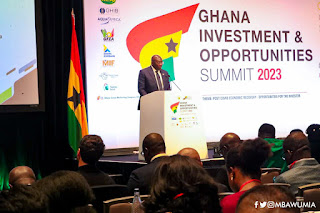
Ghana is back on track with investment opportunities - Veep woos foreign investors

Accra, June 6, GNA-Vice President Mahamudu Bawumia says Ghana's economic opportunities for private sector investors are back on track as...