17.11.06

World market will continue to determine ex-pump prices-Minister

The ex-pump prices would continue "to be determined largely by the world prices of crude oil," Mr Kofi Adda, Energy Minister told parliament on Friday.
He said the policy guiding the importation and refining of crude oil was to" maintain import parity and full cost recovery for the petroleum product."
"The deregulation of the sector is to ensure a competitive environment for private sector participation in a liberalized market," he said.
The Minister was responding to a question in parliament on measures being taken to contain ex-pump prices of crude oil in the face of rising cost of oil and petroleum products on the international market.
Mr Adda said improvements in the "efficiency of the refinery operations, the competitive nature of the private sector, as well as the investment priorities of the country will also affect the levels of ex-pump prices."
In answer to another question, the Minster said it was not true that the national grid could not be extended to the Volta Islands communities. "The grid can be extended but it is extremely expensive and relatively more complicated," he said.
The Minister was responding to a question from Mr Francis Osei-Sarfo, NDC-Krachi West, on plans to extend solar lighting systems to the Volta Island communities and places where the national grid could not be extended.
The Minister said the use of solar lighting systems was part of an overall policy of increased use of renewable energy whose implementation was being reviewed to "give strategic support to the traditional sources of power supply in the country."GNA

Limit diplomatic tax exemptions... Dr.Ako Osei

Dr Anthony Akoto Osei, a Deputy Minister of Finance and Economic Planning, on Friday called for a limit on tax exemptions granted to public and private institutions. He singled out diplomatic exemptions and said it was contributing significantly to the heavy financial loss on the state.
Dr Osei took on Parliament for also taking in too much exemptions and granting exemptions that were becoming uncomfortable to bear. He said there was nowhere in the world where diplomatic exemptions were without limits.
" In this country, we allow people, including people who make huge sums of money to enjoy exemptions without having to pay required sums stipulated by law."
Dr Osei, NPP-Old Tafo was contributing to a statement by Mr Kwadwo Agyei-Aidoo, the Vice Chairman of the Finance Committee, which sought to make the revenue collection agencies increase their collection base, boost targets and help meet national goals.
The statement also looked at means of simplifying tax payments and to seek how to reduce Ghana's reliance on donor support. He said issues of exemptions and their quantum were gradually taking a heavy toll on government finances and called on Parliament to take immediate action to arrest the situation.
To this Mr Enoch Teye Mensah, NDC Ningo Prampram, rose to ask if exemptions were not granted by and to the Executive and therefore the Deputy Minister's call should be redirected to the Executive for action. But Dr Osei argued that it was not necessarily so.
"Even then, I believe that we need to take a common stand on working to achieve increased domestic revenue mobilization." Earlier, Mr Samuel Sallas-Mensah, NDC-Upper West Akim, said the revenue agencies must work at ensuring that the monies they collected was beyond what they used as operational expenses to cover capital expenses.
He described the withholding tax concept as a lazy man's way of collecting tax and asked the Ministry of Finance and Economic Planning and the agencies to find a better way of raking in funds from people that would make refunds possible.
Mr Sallas-Mensah said the current exercise of collating a national identification system would be in futility if the issue on household numbering were not addressed.
"If this problem is not addressed, the problem of bounced cheques of tax payable by institutions, companies and individuals would remain as the owners cannot be identified."
He said at the begining of each year, the Internal Revenue Service for instance, was expected to raise provisional figures for businesses. "But this is not done. Provisional assessments do not come until as late as August when the state would be in dire need of revenue."
Mr Maxwell Kofi Jumah, NPP-Asokwa, was upbeat about the need for the implementation of the house numbering scheme that he stressed was vital for the success of the national identification project.
He said with the advent of information technology, people's homes and addresses could be found at the click of a button and urged the authorities to wake up to it.
Mr Lee Ocran, NDC-Jomoro, called on government to simplify tax processes and procedures to make tax collection less cumbersome and attractive to all. "We must make the tax forms and other documentation such as registration processes simple and not a form of punishment."
On the argument that tax registration was cumbersome and should be simplified, Dr Osei urged the house to avoid oversimplifying the tax collection and registrations process since it had the potential of opening the system to abuse.GNA

NDC supporters urged to work harder to win back power

The General Secretary of the National Democratic Congress Party (NDC), Mr Joseph Asiedu-Nketiah has appealed to supporters of the party to continue working harder to win the 2008 general elections.

Mr. Asiedu-Nketiah made the appeal at the Second General Meeting of the University of Education, Winneba branch of the Tertiary Education Institutions Network (TEIN) of the NDC at Winneba.

It was under the theme, "The role of the youth in sustaining multi-party democracy in Ghana" and was attended by a large number of party members. The Member of Parliament for Tamale South constituency, Mr Haruna Iddrisu, said the NPP government's bad governance had brought hardship to Ghanaians.


He said the NPP government had nothing good for Ghanaians and urged them to vote the party out of power and replace it with the NDC. Mr. Samuel Yaw Sukah, President of the branch, appealed to the party to incorporate the TEIN in the organizational structure of the party's activities.

He urged supporters of the party to remain united and committed in the wake of false media reports and propaganda being waged against the party.GNA

Economist raises doubt over budget figures

Dr. Nii Moi Thompson has said he is not too much convinced about the numbers provided by the Minister of Finance, Hon. Kwadwo Baah Wiredu in the 2007 Budget Statement regarding the projected Gross Domestic Product (GDP) growth rate of 6.2% by the end of the year.


Speaking to The Chronicle about his views on the budget, presented to Parliament yesterday, Dr. Thompson said the projected GDP growth rate of 6.2% would require more explanation before it will become a credible statistic.


Citing several reasons for doubting the projected growth rate of 6.2%, the Economist explained that there had been a several number of strike actions in the country during the period which would definitely lead to low productivity in the country.


Another reason he cited was the energy crisis that the country has experienced. He said these power cut lead to losses in almost all the sectors of the economy, especially the manufacturing sector.


“These unforeseen happenings, which were not there at the beginning of the year then become negatives,” he said.He said some other sector of the economy had to grow dramatically to offset this negative effect and he does not know.


“ We don’t know, somebody ought to tell us,” he queried.He promised to give a fair assessment once the information is provided. “Anything short of this would raise questions about the figures”.


He cited what happened last year about the growth rate. Earlier, he said the budget was strong in one aspect and weak in others.“In policy development, the private sector is the strongest both in terms of wealth and growth, especially with the abolition of the National Reconstruction levy and several other public-private-partnership”.


He mentioned private financing as one area.However, he said the budget fell short on human resource development and social services such as housing, which is a major issue for workers and small-scale medium enterprises especially rentals.


Dr. Thompson said not everybody could pay for four years of rent advance. This was not addressed.On good governance, he said the budget did not say anything about it, in terms of fighting corruption.


He said Ghanaians are saying high price for corruption but nothing was said in the budget to fight it. “Only the Procurement Law was mentioned,” he said.He hoped the Fair Wage Commission concept works out well.


In his opinion, a Financial Investment Analyst from the Strategic African Securities (SAS), Mr. Francis Nyoagbe, said Government is trying to put money into the pockets of Ghanaians and companies as well through the reduction of taxes through the abolition of the National Reconstruction Levy and other tax cuts.


Companies would then get enough profit for reinvestment and payment of dividends. “Whether the company would use the money the way government intended, is another matter,” he added.


He said the budget is to enhance credit in the economy, and by actually allowing the banks to publish banks’ annual rates and other fees charged. “It’s a good way of enhancing competition in the industry”.


He said customers would be able to shop for loans and be able to determine which bank is competitive and have better lending rates.Another positive thing, he stated was the intention of the government to register all property and to let people have titles to their properties.


This, the analyst said could be used as collateral for loans.Touching on investment into the energy sector, he said the investment of $470 million over the next two years was welcomed because Ghana needs a lot of energy in the country.


He however said the government should put in place a mechanism to provide incentives to the private sector to participate in the provision of energy, as government alone cannot provide all the energy needed.“Ghana is growing and a GDP of over six percent has been projected and a lot of energy is needed to propel the growth rate”.


The analyst noted that the budget is all about implementation.All the things the government has said it would do are all in its control and we would be happy if it would be implemented successfully.


Commenting on the tax incentives, the analyst said the exemptions given to the pharmaceutical industry must be replicated to the other sectors of the economy, like the services area, especially the insurance sector.


He stated that establishing a Fair Wage Commission is a laudable idea but stressed that the extent to which it would be responsive to the needs of workers is not known.


By the time the commission sets a fair wage, that wage would have been useless to the economy because of increases in prices.Mr. Nyoagbe said they have to consider utility prices and inflation in setting wages.


And if inflation and utility prices were not stable, the work of the commission would be useless, as they would have to adjust wages any time inflation goes up.
Source:http://www.ghanaian-chronicle.com/

16.11.06

President Kuffour will perform Ghana @50 anniversary launch

On March 6, 1957, Ghana became the first country in Africa south of the Sahara to gain independence from colonial rule. Next year, 2007, marks 50 years of independence.

The theme for the anniversary is: Championing African Excellence. Ghana’s first President, Osagyefo Dr. Kwame Nkrumah, envisioned this country as the guiding light of African independence and solidarity -- the BLACK STAR, the lode star of Africa.
Ghana’s attainment of independence and the subsequent ideological support it extended to other colonized countries on the continent, culminated in the emancipation of many of these countries from colonial rule.

There are three main objectives for the jubilee celebrations. They are:To celebrate and commemorate Ghana’s landmark achievement as the first country in Black Africa to attain independence from colonial rule;
To reflect on the evolution, development, achievements and drawbacks of our country over the past fifty (50) years; and to look forward to the future, to our vision of excellence in all fields of endeavour in the next fifty (50) years toward, and to our centenary birthday as a nation state.

Year-long activities marking the Golden Jubilee have been scheduled, beginning in January 2007 and ending in December 2007. The monthly themes are:
January :
Reflections
Febuary :
Towards Emancipation
March :
Freedom March
April:
Our Nation, Our People
May :
Our Wealth and Our Prosperity
June :
Heroes of Ghana Month
July :
African Unity Month
August :
Diaspora Month
September :
Service to the Nation
October :
October – Knowledge and Ghana’s Development
November :
A Healthy People, A Healthy Nation
December :
Final Curtain

BUDGET: Five billion cedis allocated for research

Mr Kwadwo Baah-Wiredu, Minister of Finance and Economic Planning, on Thursday announced that government had set aside five billion cedis in this year's budget as seed money in an endowment fund for science and technology research.
This, he said, was to encourage basic and applied research in order to generate new pillars of growth for the economy."For the purposes of encouraging basic research, government will promote the establishment of an Endowment Fund for Science and Technology Research by providing an initial allocation of A25.0 billion," he said.
Mr Baah-Wiredu said the private sector and other institutions would be encouraged to contribute to the Endowment Fund to create a regular flow of resources for basic research.
The Council for Scientific and Industrial Research (CSIR) would coordinate the initiative."The government encourages the private sector to take advantage of the generous tax incentives already in the Internal Revenue Act to step up their commercialization of research," the minister said.
He cited one such incentive package as the one given to the pharmaceutical manufacturing industries, saying that government had already granted exemptions to 66 active pharmaceutical ingredients.
"To further encourage local pharmaceutical industries to increase the supply of locally produced drugs and support the current National Health Insurance Scheme, it is proposed that VAT and import duties on raw materials and packaging materials used in manufacturing drugs for treatment of HIV/AIDS, Tuberculosis and Malaria be removed," he said.

Baah Wiredu presents next year's Budget

Minister of finance and economic planning, Mr. Kwedjo Baah-Wiredu has assured Ghanaians that government is deeply concerned about the current energy gap facing the nation and is taking steps to solve them.
He says over a billion dollars is expected from ghana's foreign donors to help in the exercise. Mr. Baah Wiredu said these today in Parliament when he presented the budget statement for the next fiscal year.
Touching on interest rates, the minister said eventhough the country experinced an exceptionally difficult year in 2005, interest rates have remained fairly within acceptable limits at 14.5 percent.
The exchange rate he mentioned, has also been relatively stable against the major benchmark (the dollar) at 9,800.00 cedis from 9,211 cedis last year.
Mr. Wiredu added that government will support the mass transportation system by helping it acquire more fleet to augment their capacity.
The full statement will be available soon.

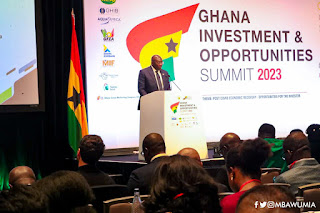
Ghana is back on track with investment opportunities - Veep woos foreign investors

Accra, June 6, GNA-Vice President Mahamudu Bawumia says Ghana's economic opportunities for private sector investors are back on track as...