The Tema Oil Refinery (TOR), on Monday morning started loading petroleum products from its rack to the various oil filling stations.
Management has therefore urged the public not to panic over any shortage of fuel in the system as it is working around the clock to ensure that the products get to the oil marketing companies and then to the designated stations.
The Public Affairs Manager of TOR, Mrs Aba Lokko explained on Monday at Tema that upon request by the Bulk Oil Storage and Transport (BOST) near Tema to replenish its storage tank, the oil marketing companies were informed on Thursday to take their allocations from Kumasi.
She said BOST then begun replenishing its stock in the tank as strategic reserve and completed on Sunday, presumably causing the temporary shortage.
Loading of petroleum products was actively taking place when the GNA visited TOR.
Mrs Lokko, however, denied any shortage of Liquefied Petroleum Gas in the system.She advised against panic buying in order not to create any problem.
Though there were no queues at the filling stations that the GNA visited as at noon, some taxi drivers claimed they bought their fuel as far as Doryumu in the Dangme West District of the Greater Accra Region.
While others blame he temporary shortage on the upcoming budget, others also thought TOR’s allegation of the adulteration of fuel had infuriated the oil marketing companies to hoard their allocations.
GNA

News from Ghana,the African Sub-Region and More!
13.11.06

Regional Workshop on Bio Fuels opens
Vice President Alhaji Alui Mahama on Monday pledged the Government's support to efforts and initiatives aimed at creating a regional fund for the development and use of bio-fuels in place of fossil fuel in Africa.
In a speech read on his behalf by Professor Dominic Fobih, Minister of Lands, Forestry and Mines, at the opening of a two-day Regional Workshop on Financing Bio fuels and Jathropha Plantation Projects with Special Emphasis on Clean Development Mechanisms, Vice President Mahama noted that the dependence on fossil energy had burdened the economies of developing countries in Africa, while most of the Continent's alternative energy resources remained unexploited.
He said even though Africa had a great potential and was well endowed with natural energy resources, investments on the Continent for the development of renewable energy such as bio-fuels was woefully inadequate.
The workshop is being organized by the United Nations Conference for Trade and Development (UNCTAD) and sponsored by the ECOWAS Bank for Investment and Development (EBID). It is being attended by about a 100 Ministers, Directors and players in the bio-fuels industry from both West Africa and the European Union (EU).
The workshop would culminate in the creation of a fund for investment into the expansion of jathropha plantations and the development of bio-fuels in West African states.
Alhaji Aliu said jathropha plantations and their resultant bio energy development would go a long way to reduce the tax burdens that came with fossil fuel importation and consumption in African economies.
"Bio diesel extracted from jathropha could be used in running stationary engines like corn mills, irrigation pumps and cottage industries - the use of bio-diesel in houses would reduce harmful carbon emissions that could cause respiratory problems," he said.
In a speech read for Mr Ernest Debrah, Minister of Food and Agriculture, he noted that jathropha oils had an advantage over vegetable oil in terms of health and besides bio-fuels from jathropha would give African economies greater independence from the shocks of constantly fluctuating international crude oil prices.
Mr Abraham Dwumaa Odoom, Deputy Minister of Local Government, said large acreages of jathropha plantation could impact on climate change in a positive way and moreover bio fuel from jathropha would ease the burden on Ghana's hydro and thermal energy sources.
The workshop would streamline all successful initiatives, identify the role of stakeholders in development of the bio-fuel supply chain and consolidate strategies and adopt a regional approach for the promotion and development of bio-fuel in Africa.
Excerpts from a research by the Netherlands-based Fuels from Agriculture in Communal Technology (FACT) Foundation made available to the Ghana News Agency indicated that jathropha plantations had been identified as a major bio-fuel alternative for West African economies.
The research stated that to date, Brazil and Malaysia were world leaders in the cultivation of jathropha, which had several additional benefits, including cure for constipation (seeds) and malaria (leaves), healing for wounds (latex or sap).
It said the jathropha plant, besides being a major source of bio-fuel when processed, also served as an effective form of hedges around gardens, farms and fields to protect crops against roaming animals, as a wind and water shield and to reduce erosion.
The report also noted that an investment into jathropha plantation, especially in Africa promised to reduce unemployment among women because the oil from the seeds was also good for soap making.
"Although Malaysia and Brazil are the biggest investor destinations for the cultivation, production and processing of jathropha, investors will select the African region if production cost in West Africa is lower," the research said.
GNA
In a speech read on his behalf by Professor Dominic Fobih, Minister of Lands, Forestry and Mines, at the opening of a two-day Regional Workshop on Financing Bio fuels and Jathropha Plantation Projects with Special Emphasis on Clean Development Mechanisms, Vice President Mahama noted that the dependence on fossil energy had burdened the economies of developing countries in Africa, while most of the Continent's alternative energy resources remained unexploited.
He said even though Africa had a great potential and was well endowed with natural energy resources, investments on the Continent for the development of renewable energy such as bio-fuels was woefully inadequate.
The workshop is being organized by the United Nations Conference for Trade and Development (UNCTAD) and sponsored by the ECOWAS Bank for Investment and Development (EBID). It is being attended by about a 100 Ministers, Directors and players in the bio-fuels industry from both West Africa and the European Union (EU).
The workshop would culminate in the creation of a fund for investment into the expansion of jathropha plantations and the development of bio-fuels in West African states.
Alhaji Aliu said jathropha plantations and their resultant bio energy development would go a long way to reduce the tax burdens that came with fossil fuel importation and consumption in African economies.
"Bio diesel extracted from jathropha could be used in running stationary engines like corn mills, irrigation pumps and cottage industries - the use of bio-diesel in houses would reduce harmful carbon emissions that could cause respiratory problems," he said.
In a speech read for Mr Ernest Debrah, Minister of Food and Agriculture, he noted that jathropha oils had an advantage over vegetable oil in terms of health and besides bio-fuels from jathropha would give African economies greater independence from the shocks of constantly fluctuating international crude oil prices.
Mr Abraham Dwumaa Odoom, Deputy Minister of Local Government, said large acreages of jathropha plantation could impact on climate change in a positive way and moreover bio fuel from jathropha would ease the burden on Ghana's hydro and thermal energy sources.
The workshop would streamline all successful initiatives, identify the role of stakeholders in development of the bio-fuel supply chain and consolidate strategies and adopt a regional approach for the promotion and development of bio-fuel in Africa.
Excerpts from a research by the Netherlands-based Fuels from Agriculture in Communal Technology (FACT) Foundation made available to the Ghana News Agency indicated that jathropha plantations had been identified as a major bio-fuel alternative for West African economies.
The research stated that to date, Brazil and Malaysia were world leaders in the cultivation of jathropha, which had several additional benefits, including cure for constipation (seeds) and malaria (leaves), healing for wounds (latex or sap).
It said the jathropha plant, besides being a major source of bio-fuel when processed, also served as an effective form of hedges around gardens, farms and fields to protect crops against roaming animals, as a wind and water shield and to reduce erosion.
The report also noted that an investment into jathropha plantation, especially in Africa promised to reduce unemployment among women because the oil from the seeds was also good for soap making.
"Although Malaysia and Brazil are the biggest investor destinations for the cultivation, production and processing of jathropha, investors will select the African region if production cost in West Africa is lower," the research said.
GNA
GJA condemns police attack
The Ghana Journalists Association (GJA), on Monday condemned the attack on Journalists by police last Friday saying the development was a dangerous snag in Ghana's impressive showing on global press freedom ratings.
A group of heavily armed policemen from Tema, Ada and Kisseih, for no just cause, brutalized media personnel assigned to cover a press conference held at Kportsum, near Ada on November 10, 2006.
A statement signed by Mr. Bright Blewu, General Secretary of the GJA said the police were also alleged to have manhandled the organizers of the press conference held at a no-security zone by the Ada Songor Land Owing Clans to state their position on the administration of the Songor Salt Project by the Interim Management Committee.
"The GJA is extremely concerned about the latest incident, especially when it was carried out by the police and condemns it in no uncertain terms."
It said there had been not less than six such attacks on journalists and photojournalists already this year and urged the Police Council to order an investigation into the matter and bring the perpetrators to book.
The statement said the GJA has written to Mr. Albert Kan Dapaah, Minister of the Interior and Mr. Patrick Acheampong, Inspector General of Police seeking audience with them separately sometime this week, to discuss the upsurge in physical attacks on the media personnel in Ghana.
A group of heavily armed policemen from Tema, Ada and Kisseih, for no just cause, brutalized media personnel assigned to cover a press conference held at Kportsum, near Ada on November 10, 2006.
A statement signed by Mr. Bright Blewu, General Secretary of the GJA said the police were also alleged to have manhandled the organizers of the press conference held at a no-security zone by the Ada Songor Land Owing Clans to state their position on the administration of the Songor Salt Project by the Interim Management Committee.
"The GJA is extremely concerned about the latest incident, especially when it was carried out by the police and condemns it in no uncertain terms."
It said there had been not less than six such attacks on journalists and photojournalists already this year and urged the Police Council to order an investigation into the matter and bring the perpetrators to book.
The statement said the GJA has written to Mr. Albert Kan Dapaah, Minister of the Interior and Mr. Patrick Acheampong, Inspector General of Police seeking audience with them separately sometime this week, to discuss the upsurge in physical attacks on the media personnel in Ghana.
Offshoring: Coming Trend for Copy Desks?
A newsroom, bedeviled by missed deadlines, a short-handed copy desk and a lack of editing candidates, gets creative.
It finds a company that offers editing services. The company is overseas, perhaps in India or Singapore.
Powered by fiber-optic connections that carry data all the way around the world in less than a second, the off-shore company offers a money-back guarantee on deadline performance. In a pinch, it could throw 30 editors at an edition, three times as many as the newspaper could ever afford to deploy in its own office.
The quality is good. Hundreds of thousands of people in India grow up in English-speaking schools, and they're working hard to build careers. The work is cheap by U.S. standards. The rate is a third less than what the American newspaper is paying. There are no health benefits, vacations or sick days, and no utility or equipment costs to the newspaper.
Could it happen? In some respects (though not yet the copy desk), it already has.
The Chicago Tribune is moving the work of 40 circulation customer-contact workers to APAC Customer Service in the Philippines. The newspaper reported that this follows a similar action by its sister, the Los Angeles Times.
The New York Times reported that, in its last months, Knight Ridder considered whether it could consolidate copy editing among widespread papers. It's not that big a leap to move that desk overseas.
Stateside copy editors, traditionally on the right side of supply-and-demand job security, are on the wrong side of offshoring. Some of the safest jobs in the newsroom are becoming the most exportable.
One company, Hi-Tech Export, offers 40 hours of proofreading and copy editing for $295. The company, located in Ahmedabad, India, started in 1992 and did data processing for other Indian companies. It has expanded its offerings and, since 2000, has been developing markets in the United States, Canada, Europe and Australia. Its U.S. office is in Omaha.
Another company, Cicada Media in Bangalore, India, focuses on corporate and marketing communications. It offers to correct errors in grammar, spelling, usage and style, and to proofread. Sound familiar?
At The DallasMorning News recently, as people awaited word on buyouts, they griped that their in-house tech questions often were handled by techies in India.
As a recruiter, I frequently get e-mails from people in India offering to work for the Detroit Free Press. Immigration would not be an issue, as they don't plan to move. They are offering, in effect, to be trans-world telecommuters. Their pitches, naive and off-the-mark at first, are getting sharper.
Going in the other direction, U.S. companies are advertising for copy editors now on Monster India, the overseas cousin of the Monster.com job site we know here.
Hi-Tech is not the problem. Nor is Cicada nor Monster nor any company in particular. The problem is that globalization, digitization and tight supply-chain management let all kinds of companies break down jobs, divvy up the parts, ship the components around the world to the best bidders and reassemble them all by deadline. The Newspaper Guild and others have fought offshoring, but protesting won't dent the incentives.
The challenge of segmentation is also the key to survival.How can copy editors -- or any workers -- protect their jobs?
The challenge of segmentation is also the key to survival. Break down the job, analyze the components and take the parts you can do best. New York Times writer Thomas L. Friedman, who laid out scenarios like this in "The World is Flat," differentiates between high-value custom work and "plain vanilla" exportable tasks. The vanilla gets gobbled up first.
The parts of a copy editor's job that would seem most vulnerable to offshoring are also the most mundane: reading proofs and editing calendar listings. How could someone overseas have enough local knowledge to edit calendar listings? The same way someone might adopt an American name and learn a regional U.S. accent to provide more comforting service from a call center 12 time zones away. It can be done.
How about wire stories? How much better are we in my newsroom in Detroit at editing stories from Asia than, say, a person in India? We know our market better, but we are further from the story. Wire stories, which receive a couple of edits before they ever get to us, could be vulnerable to offshoring. Recently, I have seen one newsroom run a shared-content, international-news page that is put together by a nearby neighbor. It works pretty well. And it is not a huge leap to have that page put together 10,000 miles away.
In 1998, an American Journalism Review project on the state of American journalism titled a piece on dwindling foreign reporting as "Goodbye, World." What's next, "Goodbye, Work"?
Anyone with a good job would fight to keep it. Fighting change may be futile. The smarter fight lies in developing the skills required to make yourself not only more essential but more satisfied and competent in the work you want to do.
source : http://www.poynter.org/column.asp?id=83&aid=112040
It finds a company that offers editing services. The company is overseas, perhaps in India or Singapore.
Powered by fiber-optic connections that carry data all the way around the world in less than a second, the off-shore company offers a money-back guarantee on deadline performance. In a pinch, it could throw 30 editors at an edition, three times as many as the newspaper could ever afford to deploy in its own office.
The quality is good. Hundreds of thousands of people in India grow up in English-speaking schools, and they're working hard to build careers. The work is cheap by U.S. standards. The rate is a third less than what the American newspaper is paying. There are no health benefits, vacations or sick days, and no utility or equipment costs to the newspaper.
Could it happen? In some respects (though not yet the copy desk), it already has.
The Chicago Tribune is moving the work of 40 circulation customer-contact workers to APAC Customer Service in the Philippines. The newspaper reported that this follows a similar action by its sister, the Los Angeles Times.
The New York Times reported that, in its last months, Knight Ridder considered whether it could consolidate copy editing among widespread papers. It's not that big a leap to move that desk overseas.
Stateside copy editors, traditionally on the right side of supply-and-demand job security, are on the wrong side of offshoring. Some of the safest jobs in the newsroom are becoming the most exportable.
One company, Hi-Tech Export, offers 40 hours of proofreading and copy editing for $295. The company, located in Ahmedabad, India, started in 1992 and did data processing for other Indian companies. It has expanded its offerings and, since 2000, has been developing markets in the United States, Canada, Europe and Australia. Its U.S. office is in Omaha.
Another company, Cicada Media in Bangalore, India, focuses on corporate and marketing communications. It offers to correct errors in grammar, spelling, usage and style, and to proofread. Sound familiar?
At The DallasMorning News recently, as people awaited word on buyouts, they griped that their in-house tech questions often were handled by techies in India.
As a recruiter, I frequently get e-mails from people in India offering to work for the Detroit Free Press. Immigration would not be an issue, as they don't plan to move. They are offering, in effect, to be trans-world telecommuters. Their pitches, naive and off-the-mark at first, are getting sharper.
Going in the other direction, U.S. companies are advertising for copy editors now on Monster India, the overseas cousin of the Monster.com job site we know here.
Hi-Tech is not the problem. Nor is Cicada nor Monster nor any company in particular. The problem is that globalization, digitization and tight supply-chain management let all kinds of companies break down jobs, divvy up the parts, ship the components around the world to the best bidders and reassemble them all by deadline. The Newspaper Guild and others have fought offshoring, but protesting won't dent the incentives.
The challenge of segmentation is also the key to survival.How can copy editors -- or any workers -- protect their jobs?
The challenge of segmentation is also the key to survival. Break down the job, analyze the components and take the parts you can do best. New York Times writer Thomas L. Friedman, who laid out scenarios like this in "The World is Flat," differentiates between high-value custom work and "plain vanilla" exportable tasks. The vanilla gets gobbled up first.
The parts of a copy editor's job that would seem most vulnerable to offshoring are also the most mundane: reading proofs and editing calendar listings. How could someone overseas have enough local knowledge to edit calendar listings? The same way someone might adopt an American name and learn a regional U.S. accent to provide more comforting service from a call center 12 time zones away. It can be done.
How about wire stories? How much better are we in my newsroom in Detroit at editing stories from Asia than, say, a person in India? We know our market better, but we are further from the story. Wire stories, which receive a couple of edits before they ever get to us, could be vulnerable to offshoring. Recently, I have seen one newsroom run a shared-content, international-news page that is put together by a nearby neighbor. It works pretty well. And it is not a huge leap to have that page put together 10,000 miles away.
In 1998, an American Journalism Review project on the state of American journalism titled a piece on dwindling foreign reporting as "Goodbye, World." What's next, "Goodbye, Work"?
Anyone with a good job would fight to keep it. Fighting change may be futile. The smarter fight lies in developing the skills required to make yourself not only more essential but more satisfied and competent in the work you want to do.
source : http://www.poynter.org/column.asp?id=83&aid=112040
Minister lauds NAGRAT decision to call off strike
 Papa Owusu Ankomah, the Minister of Education, Science and Sports, says while the decision by NAGRAT members to call off their strike was a relief to all they must consider constraints of the economy that would not allow the government to meet all their demands.
"I thank them very much for their decision to go back to the classroom but they must know that economic constraints will not allow the government to give them everything they are asking for".
The Minister was addressing an extraordinary meeting of New Patriotic Party (NPP) Polling Station Executives in the Sekondi Constituency at Sekondi on Sunday.
He said the government was dialoguing with NAGRAT leaders on their demand for better conditions of service for their members and that it was wrong to give the government pre-conditions before returning to the classroom.
He said a comprehensive salary structure that would eliminate disparities in salaries of workers was being worked out and advised workers to operate within the ambits of the law and exercise restraint in labour disputes.
Papa Owusu Ankomah dispelled the notion that the government was weak in cases where some individuals or groups were seen to be flouting the laws.
"NPP is a democratic party trying to entrench democracy in the country and will always want the law to take its course".
Papa Ankomah urged party activists to remain loyal, "preach the good news" and work hard to intensify membership drive.
The Minister said the government was on track and had delivered on its promise to revamp the economy and improve all sectors including education and sports to bring improvement in the lives of the people.
He said the introduction of the capitation grant and the school feeding programme in some areas was only to supplement the efforts of parents to educate their wards. Mr. Kwadwo Acquah, the Western regional NPP Organiser, called for strong bonds of unity among members and denounced the activities of some members who vilify and castigate others members of the party and said this tended to damage the image of the party.
"All the sacrifices we gave and the hardship we went through when we were in opposition seems to have been forgotten and some of us are trying to destroy the party's image by their utterances".
Mr. Acquah warned that those whose activities were found to be inimical to the well being of the party would be forced to resign.
GNA
New malaria drug dispensed without serious side effects
 About 1.8 million doses of the new malaria drug, artesunate-amodiaquine, have been dispensed without serious side effects, Dr. Eugene K. Amable of the University of Ghana Medical School, has said.
He was speaking at the scientific session of the just ended 48 annual conference of the Ghana Medical Association (GMA) in Ho under the theme, "Environmental sanitation law and order and health".
Dr Amable said the drug had proved to be 97 percent effective against malaria as against chloroquine's 75 percent.
He said the drug was the first choice drug for the treatment of malaria in 19 African countries.
Dr Amable said the drug was subject to thorough scientific tests and evaluation and was found to be a better choice in terms of efficacy and cost.
He said it was scientifically wrong for the country to continue to depend on chloroquine for the treatment of malaria when its efficacy was assessed to be 75 percent.
GNA
Make assemblies accessible to the people - Minister
Mr Stephen Asamoah-Boateng, the Minister of Local Government, Rural Development and Environment, has urged district assemblies to adopt an open door policy to enable people to have easy access to their services.
He said such a move would not only make people understand the district assembly concept better but also enhance the decentralisation process.
Mr Asamoah-Boateng said this when addressing a public forum to explain government policies and programmes at Konongo in the Asante-Akim North District last Friday.
He said the import of decentralisation process was to bring governance closer to the people hence denying them access to the assemblies would defeat the purpose for which it was introduced.
The minister expressed concern about the bureaucratic nature of most assemblies that he said tended to frustrate people from patronising services being provided by such assemblies.
He noted that rendering service to the public required time as well as patience and charged staff of the various assemblies to render selfless service to the people in order to give true meaning to local governance.
"The time has come for district assemblies to be turned into viable centres for economic growth hence rendering quality services to the people can not be undermined."
He implored district assemblies to strive to be people-centred in their operations since their output would eventually serve as a yardstick to measure the performance of central government.
Subscribe to:
Comments (Atom)
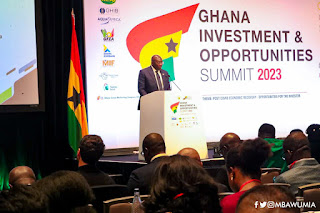
Ghana is back on track with investment opportunities - Veep woos foreign investors
Accra, June 6, GNA-Vice President Mahamudu Bawumia says Ghana's economic opportunities for private sector investors are back on track as...
-
 John E.A Mills died today at a Military Hospital in Ghana. He was 68. He became Ghana's President in 2009 after winning a general ...
 -
 A number of African Heads of State have started arriving in Accra to attend the second conference of the "Partnership with Africa...
 -
 The National Media Commission (NMC) has reconstituted the Board of Directors for State-Owned Media organisations in consultation with Presi...