9.11.06

Oxfam report-More Children still out school despite all efforts

Four out every 10 Ghanaian children of school going age do not go to school despite the introduction of the Capitation Grant and the Free Compulsory Basic Education programmes, Oxfam, report has said.
The findings form part of the Great Britain's Oxfam new international report for 2006.
It said one in three children would soon be leaving primary school if efforts were not intensified to ensure that they go to school, stay and complete their education.
Mrs. Sonia Kwami, Education Programme Officer of the Oxfam Ghana Office said this when she gave the highlights of the report at a press conference in Accra.
The report, which will be officially launched in December, has the title: "In the Public Interest" and a country level theme, "2007 National Budget should prioritise public health, education, water and sanitation as key to poverty reduction".
"With discussions underway about the 2007 budget, now is a crucial time for the government of Ghana to work on behalf of its citizens and lock in its financial commitment to cutting poverty, improving access to education and overhauling the health care system, hence the highlights of the report", she added.
Mrs. Kwami said education should be a crucial component if Ghana would like to continue with its steady progress towards becoming a leader in the global struggle for parity for the developing world.
She said there was the need for government to invest in essential social services such as education, sanitation and water if Ghana wanted to meet the targets of the Millennium Development Goals in 2015.
She explained that there was a shortfall of 17,612 basic schoolteachers resulting in many school children dropping out of school, adding "Ghana needs about 18,000 more well trained teachers who would be well compensated so they may walk into the classrooms confident and prepared to educate our children".
Citing the recent strike embarked on by the NAGRAT, she called on the government to be paying "decent salaries for those good and competent people who have the responsibility of educating our children”.

Mrs. Kwami noted that Ghana was far behind its pledge in spending 15 per cent of its national budget on providing quality health care to the people of Ghana.
She said government's recent efforts in reforming the national health insurance scheme was a good step, "but will have to triple spending on health in order to meet a goal that was set in solidarity across the Economic Community of West African States".
She said there was need for government to continue with its support and expand of the HIV/AIDS prevention and treatment efforts and be committed to other basic health care needs of the people.
Mrs Kwami urged government to ensure that Ghanaians irrespective of their locality have access to clean and portable drinking water and ensure environmental cleanliness to prevent the upsurge of diseases.
Dr Nii Moi Thompson an economist, who chaired, said the development of the county should be based on human welfare and not on Gross Domestic Product (GDP).
According to him social spending has increased from 30.4% in 1999 to over 40% in 2006 and yet "there has not been any social impact of this increment"
He noted that education; health and water, which were essential for human development, still elude the people and urged government who had the wider option to formulate good policies that would raise domestic resources to deal with the social problems.
GNA

Ghana to be certified as polio-free state


Ghana has succeeded in recording no wild polio virus for three-continuous years, a sign of successful eradiation of polio, Dr Kwadwo Antwi-Agyei, Programme Manager of the Expanded Immunisation Programme of the Ghana Health Service, said on Thursday.
Speaking to the Ghana News Agency (GNA) in an interview in Accra Dr Antwi-Agyei explained that Ghana, since September 2003 recorded no virus and the only way to maintain a polio-free state was to ensure high immunity levels for children under-five years.
He said in 2003 when Ghana was about to complete its third year to be certified as a polio-free state, "We had eight imported cases from February to September from Nigeria and that took us back gain and we started all over again.”
Dr Antwi-Agyei told the GNA that after meeting all the requirements to become a polio-free country, it was left with the World Health Organisation (WHO) to assess and certify the country as polio-free.
"Though we will be certified as polio-free, we will still stand at risk once our neighbour Nigeria had more than 500 cases in 2005 and about 847 cases as at October 3, 2006; we have to intensify our high immunity levels and be alert on our borders."
Dr Antwi-Agyei said though measles was still the leading cause of illness among the vaccine preventive diseases for children under-five years, no death had been recorded for the past two years.
He said there had been a dramatic fall from 13,476 suspected cases in 2001 to 487 cases in 2005 after a large outbreak in 1995, which recorded over 44,000 cases and 85 deaths.
Dr Antwi-Agyei noted that measles was in the early 1980s ranked second to malaria in terms of burden of diseases accounting for 7.3 per cent of the healthy days of life lost through illness, disability and death.
He explained that measures were put in place to control the outbreak, which involved intermittent vaccination. Measles vaccination has since been incorporated in routine immunisation of children at nine months of age.
Dr Antwi-Agyei noted that measles was a highly contagious disease, caused by a virus and its control required very high population immunity and gave the assurance that the vaccines that were given at the just-ended Integrated Child Health Campaign were safe and highly effective.
He explained that indicators used in achieving the fourth target of the Millennium Development Goals, which target the reduction by two-thirds under-five mortality, had a proportion of under-one year old children immunised against measles.
"This can be done if districts attain more than 90 per cent coverage consistently," he said.
He described measles as a killer disease, which when complicated, caused blindness, diarrhoea, sore in the mouth, affected the brain, enteritis and pneumonia. He urged mothers to ensure that their children took the first dose at the age of nine months and the second dose during the campaign exercise which will come off in November.
Dr Antwi-Agyei mentioned symptoms of measles as fever cough rashes and redness of the eyes and urged mothers to watch for these signs and report immediately to the nearest clinic.
He described the last immunization exercise as successful and said there were indications that the target set would be achieved though they were now compiling their reports.
The exercise, which started on November 1 and ended on November 5, combined measles and polio immunisation, administering of vitamin A and distribution of 2.1 million free Insecticide Treated Nets (ITNs) to children less than two years.
About 5.959 million children from 0-59 months were immunised against polio and about 5.065 million children from nine months to 59 months were vaccinated against measles.
There were 9,050 immunisation points, 9,505 vaccinators and 28,514 volunteers to ensure that all children were covered.

Negotiations for teachers still in progress

Negotiations between the Ghana Education Service (GES) and the Ghana National Association of Teachers (GNAT) on salary proposals and collective agreement are still going on, the GES announced on Thursday.

A statement signed by Mr Samuel Bannerman-Mensah, Chairman of the Joint Negotiating Committee, said teachers and the general public would be informed about the outcome “as soon as negotiations are concluded”.
The statement gave no further details.

La Traditional Council takes Ghana@50 to court


An Accra High Court on Thursday ordered the La Traditional Council (LTC) to file an Application on Notice when it appeared before it with an Ex-Parte Motion on a disputed land at La Wireless in Accra, which is being developed by the Ghana@50 Secretariat.

The Court said its order became necessary because by coming on an Ex-Parte Motion, the Council was asking the Court to hear its side only without listening to the other party in the suit. By coming on Motion on Notice, however, the Court would then serve the other party so that both sides would have the chance to be heard by the court.

Last week, Mr Peter Ala Adjetey, former Speaker of Parliament, filed an interlocutory application at the Fast Track Court on behalf of the LTC praying the Court to restrain the Ghana@50 Secretariat from developing a piece of land at the La Wireless Station until the case had been fully heard.

Since the on-going project belongs to government, a copy of the Motion on Notice, when and if it is filed by the LTC, would be served on the Attorney-General.

The Court would then fix a date for counsel on both sides to make their submissions after which it would give its ruling. Mr William Addo represented LTC.

The Ghana@50 Secretariat is using a portion of the land on behalf of government for the construction of a number of presidential suites to accommodate presidents and high profile foreign dignitaries who would be attending the country's Golden Jubilee Celebrations in March next year. In 1950, government compulsorily acquired the land in question for a wireless project, but the project was later abandoned and the land was lying fallow.

Recently, the La Youth said it detected that the land was being developed and therefore reported the matter to the Council. Not satisfied with government's decision to use the land for the Golden Jubilee Project, the LTC said it was compelled to seek refuge at the law courts to get the matter resolved.

Consequently, it filed the interlocutory application at the Fast Track Court last week asking it to restrain the Secretariat from continuing with the project.Source:
GNA

UN asked to be proactive in controlling WMD


The Vice President, Alhaji Aliu Mahama, on Thursday asked UN member States to be proactive in the control and movement of Weapons of Mass Destruction (WMD) to make global peace and stability a reality.

He expressed the need for the implementation of legislations that would ban the manufacturing of WMD to facilitate development. Alhaji Mahama was speaking at a meeting with Mr. Nobuaki Tanaka, UN Under-Secretary-General for Disarmament Affairs at the Osu Castle. Alhaji Mahama said although some countries in the developed countries were proliferating WMD, Ghana remained committed to all UN ideals and resolutions to reverse the trend.

He said it was only through peace and security that the developing countries could nurture their development objectives, adding that this dream had inspired Ghana to play pacific roles n war- torn countries in the West African Sub-Region.

Mr Tanaka is in Ghana to attend a two-day seminar on the implementation of the United Nations Security Council resolution 1540 (2004), which seeks to impose binding obligations on all states to take measures to prevent the proliferation of WMD, particularly for terrorist purposes.

He said the Accra seminar, which was the second after China would be followed by a similar event in Peru.

Mr Tanaka said the UN was committed to assist African states to deal with the problem of small arms proliferation through the enactment of laws that would make the activity criminal.

He said proliferation of small arms was a major security concern globally and expressed regret that the Beijing seminar could not resolve the problem.

Mr Tanaka said the international environment on WMD was not favourable, citing the Iran and North Korea nuclear stand-off. He said peace was an indivisible issue, adding 93Whether we like it or not, terrorists can move into any country without consent.=94Source:
GNA

NPP flagbearer aspirant writes on "Presidential Temperament"


A decade ago, after then President Rawlings physically assaulted the Vice-President, I wrote an Op-Ed on the above. I return to this topic again because of the public quarreling of John and John, the President and his predecessor. This is an appropriate topic with which to begin my blog.

To put it bluntly, the ceaseless feuding between Ex-President Rawlings and President Kufuor is prejudicial to Ghana’s interest. Here is why. First, as a nation whose memory has been scarred by the history of coups, our morale is inevitably disturbed by the shrill exchange of charges between our two most prominent citizens. This is particularly so when the former president has been associated with coups in the past. Second, while
the President works tirelessly to attract Foreign Direct Investments ( FDI), most foreign investors look for stability in a country they plan to invest in. Reports or evidence of the President and former President trading accusations and the military brass re-iterating its loyalty to the current government makes them less likely to invest in Ghana and thus retards our economic growth. Third, the energy and time focused on their quarrels saps the will and focus that our leaders and institutions need to work on our development.

There has been a lot of finger-pointing between supporters of the two Presidents on who is to blame for the state of their relationship and this has divided along partisan lines.

This is unfortunate. It is one in a long line of problems that have nothing to do with parties, including the cocaine scandal.

The former President, right from day one, has not been supportive of his successor. He has been critical of him both at home and abroad. Indeed, he has accused Britain and United States of propping the Kufuor administration up unfairly. This accusation is strange when one recalls how the West, particularly President Clinton was supportive of President Rawlings. Furthermore, he has accused the Kufuor administration of human rights abuses in a manner that given his own well-chronicled abuses, is audacious.

He has studiously refused to give the President credit for anything. If all this gives anyone the impression that I think the President is blameless, that is false. True, in dealing with a confirmed two-time coup-maker, the President has more than ample reason to be wary. However, he has shown some lapses in judgment and decorum while dealing with President Rawlings. To focus just on the current controversy, a campaign
appearance was not the proper forum to accuse the former President of planning a coup. Indeed, the only appropriate place for such an accusation should have been in a Ghanaian court-room, by a prosecutor!

The situation is unnecessarily exacerbated by my-boss-is-right supporters and advisors forever re-echoing whatever their hero has said in blatant disregard of the nation’s interest.

Historically, some nations have benefited a lot from collaborative relationships between their leaders and their predecessors. One example will suffice. In 1985, US President Reagan met with Ex-President Nixon who was planning to visit the new Soviet leader Michael Gorbachev in Moscow. They talked about the Soviet Union in general.

When Mr Nixon met Gorbachev, he told Mr Gorbachev of how much Mr Reagan respected him and looked forward to working with him, with a little embellishment. Of course, with that opening, Gorbachev also had some positive things to say. When Mr Nixon returned, he reported on his trip to President Reagan in terms perhaps more positive than warranted by the facts. That visit by President Nixon is seen as one of the critical catalysts to the Reagan-Gorbachev collaboration that ended the Cold War. This was an example of a former
President helping a successor to advance his nation’s interest. That is the true measure of a patriot.

We need our ex-President to be supportive of the current President. We need our President to exercise more circumspection in reacting to the tantrums of his often misguided predecessor. Our nation’s interest requires it. Here is how to approach the situation.

First Mr Rawlings must, in keeping with the temperament required of his status, pledge
NEVER to criticize the President personally in public and acknowledge that he, like every
Ghanaian is not above the law.

Second, the President must be mindful of how he addresses sensitive national issues. A leader
communicates in words as well as deeds and in certain situations, deeds may be more
appropriate than words.

Third, the Armed Forces and Security Agencies must resist the temptation to be drawn into
these verbal exchanges. Issuing a statement to re-affirm loyalty to the government each time
there is an incident only underlines how fragile our democracy is. If there is evidence that the
former President is plotting a coup, the place to address that is in court.

Fourth, the advisors of the two protagonists must counsel restraint and conciliation rather than
confrontation whenever there is thorny issue between their bosses.

Fifth, the Press must exercise judgment in reporting the pronouncements of our leaders. The
Press may have a right to publish everything but it is not right to publish everything!

Finally, the guide for all of us, the President, the ex-President, the Press, the armed forces and
the public should be our nation’s interest and a clear signal to the two John’s that we expect
them to behave as grown-ups.

Ghana Osee Yeee! Yee Yeee!
By:- Arthur Kobina Kennedy

Load Shedding to be relaxed


There are indications that the on-going load shedding exercise will be relaxed, over the next few days.

Currently, the pattern is that areas go off, once in 72 hours (three days). The new pattern is likely to be areas having power off once in five days, only in the evenings. There will not be any load shedding in the mornings.

Energy analysts believe that the Volta River Authority (VRA) and the Electricity Company of Ghana (ECG) are trying to avoid a situation in March 2007, at the peak of Ghana’s 50th anniversary celebrations, in which there will have to be load shedding. February is regarded as a drought month and there is the need to be wary.

There is likely to be a freeze on the load from December 23rd 2006 to January 3, 2007.

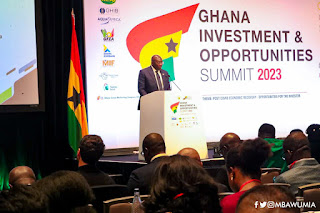
Ghana is back on track with investment opportunities - Veep woos foreign investors

Accra, June 6, GNA-Vice President Mahamudu Bawumia says Ghana's economic opportunities for private sector investors are back on track as...