8.11.06

NAGRAT obeys courts rulling.


The National Association of Graduate Teachers (NAGRAT) on Wednesday communicated the ruling of the Accra Fast Track High Court that declared their strike illegal and therefore ordered them to return to the classroom.

A terse statement signed by Mr Marjore Affenyi, Publicity and Organising Secretary of NAGRAT, said:

"The Accra High Court (Fast Track Division) has ruled that the strike action by teachers is illegal and should be called off. The court by its ruling has ordered all NAGRAT members to return to the classroom. We are by this release communicating the ruling of the court to members."

Mr Kwami Alorvi, President of NAGRAT, told the Ghana News Agency in an interview that they were obeying the court.

"We are obeying the ruling of the court," he said. "We have filed an appeal against the ruling, but the date has not been fixed as yet. That is why we are taking this action."

NAGRAT embarked on a crippling strike action on September 1 that has kept them away from the classrooms and put the future of students, especially SSS 3 students who would be writing their examinations in May/June next year, at risk.

Several efforts by various groups to end the strike failed and some members of the rival teachers union, Ghana National Association of Teachers (GNAT) also joined the strike.

Some regional branches of NAGRAT have called off the strike and asked members to resume teaching.

The strike action was to back demands on the government to review salaries of workers, especially those of teachers.

The graduate teachers also asked the Controller and Accountant General to stop the use of Auto Code that effects deductions from teachers' salaries and a replacement of the Acting Director of the GES, Mr Michael Nsowah, whose compulsory retirement was due last year. They further asked the government to implement all outstanding grievances on which Memoranda of Understanding (MOU) had been signed, including invigilation allowances for Senior Secondary School Certificate Examination (SSSCE).

They also called for a meeting between the West African Examination Council (WAEC) and the GES to discuss invigilation fees. Other issues included the implementation of adjustment in salaries and ranks of Assistant Director and above, meaningful responsibility allowances to be put in place by the GES and its Council for all teachers and payment of arrears for teachers recruited in the 2003/2004 academic year.

An Accra Fast Track Court on October 31 ordered the striking members of NAGRAT to call off their strike to return to the classroom. The court ruled that the President of the NAGRAT, Mr Kwami Alorvi, the vice president and all regional officers of the Association should return to the classrooms and teach according to their conscience. The ruling followed an application filed by the National L9abour Commission (NLC) praying the court to order members of NAGRAT to call off their strike action.

The court, presided over by Mr Richard Asamoah, said NAGRAT should use proper means to achieve its objectives.

"The court will not give room to lawlessness in the country," it ruled.

The Court also asked NAGRAT "to teach according to the laws and their conscience".

The NLC filed a suit on October 11 seeking, among other things, an order under Section 172 of Act 651 of the Labour Act, to compel the leadership in particular, and members of NAGRAT in general, to comply with the Commission's order directing them to call off the illegal strike.

Papa Owusu-Ankomah, the Minister of Education, Science and Sports, on Tuesday commended the graduate and other professional teachers on efforts to educate the future manpower and leadership of the country. However, he told Parliament, "We do not believe the reasons adduced by the current leadership of NAGRAT, whether at the regional level or national level to call for a strike action instead of a dialogue is the best in the interest of our mother land."

He said negotiations on the new salary levels for teachers were underway and would be considered within the general context of the comprehensive Public Sector Pay Reform.Source:
GNA

TOR to blacklist fuel stations selling adulterated fuel


The Tema Oil Refinery (TOR) is to name and shame cheating fuel service stations selling adulterated fuel to the public.

TOR says its independent checks have revealed extensive adulteration of fuel in some parts of the country and has scheduled a press conference on Wednesday where it is expected to name the specific filling stations involved.

The findings, part of a survey conducted by the Refinery at about fifty fuel service stations around the country a month ago, showed quite a significant number of them were selling adulterated fuel.

This confirms complaints by some car dealers who say they are having to replace more than the usual number of vehicle parts as a result of the problem.

Report indicate that filling stations in the Volta Region are the worst offenders.

7.11.06

Vice President Mahama urges private sector to promote the arts


The Vice President, Alhaji Aliu Mahama, has appealed to the private sector to play a more visible role in promoting the arts in the country. "I want to use this opportunity to appeal to the private sector, the engine of our economic growth, also to become the engine of our cultural development", he said while launching a book entitled 'Journey', written by Dr Gheysika A. Agambila, Senior Lecturer at Ghana Institute of Management and Public Administration (GIMPA), in Accra on Tuesday.


Alhaji Mahama urged the private sector to sponsor out-door sculpture at public spaces, as well as competitions in dance, theatre and creative writing in district and regional capitals. "We shall give due recognition to such good corporate citizens.”

He said what distinguishes Ghana from other nations was not the country’s production of material things. "It is our culture. Our struggle for nationhood is not only about harnessing our resources for our material well-being".


Alhaji Mahama pointed out that the struggle for nationhood was not a one-time event, but a continual struggle to preserve, develop and promote culture as Ghanaians and as Africans. “It is not only our lands that were colonized, but our minds were also colonized. We had largely freed our land from the colonizers, but what of our minds?” he asked.


He stated that if the nation should be truly free, then Ghanaians should first be proud to be Ghanaians and Africans. He said the struggle for the preservation, development and promotion of the nation’s culture was a sacred one, waged by forebears. "We must continue this eternal and sacred struggle so that generations to come will not be lost".


The Vice President said those who have read the book and are scholars of English Literature at the University of Ghana, Legon were convinced that the book and its author will surely help redefine the national literary landscape.
"I see this literary work to be a contribution to our cultural development," he reiterated.


He said much of what mankind knows was captured in books, and asked: "How shall we know, if we don't read?” The Vice President also urged adults to read often, if they wish to keep relentless senility at bay. "If we the adult don't read, what message are we sending to the youth".


The first copy of the novel was auctioned at 5.5 million cedis. It has a retail price of 50,000 cedis and would be made available at the University bookshop, the EPP bookshop and other supermarkets.

Sub-Saharan Publishers, EPP Books and Dr Agambila published the book.
Dr Agambila, a former deputy Minister of State at Harbours and Railways, spent four years to produce the book. It is about a grandfather who sees the world around him changing in post-independence Ghana.

This grandfather’s ambition was to get sugar, literally meaning money in the story, so he sent his eldest son to work in Southern Ghana, considered to be a land of opportunity, especially to Obuasi where gold is mined.


The son got married and had two kids and did not go home often. “Migration changes things”, but grandfather’s plans were further thwarted when his son was killed in a mine accident. So he sent out the second son, who also ended up in Accra, via a fufu pounding stint in Kumasi to seek greener pastures.


“The Journey, that is this life, has unexpected happenings, including endings”.
Dr Agambila has worked with Ernst and Young (Ghana) and taught at the University of Ghana, Business School. He also served as a Deputy Minister of State at the Ministries of Finance and Economic Planning, and Environment and Science.
He is also the author of "Solma, tales from Northern Ghana", a collection of short stories for children.

Dr Paa Kwesi Nduom, Minister for Public Sector Reform, chaired the launch.
He said the novel was written in sober, yet often moving style, and rich in the way it reflects the realities of the Ghanaian post-colony.


"It is based, as the title suggest, on a 'simple' journey storyline and presents credible characters whose actions and experiences hold the readers' interest unwavering".

The Minister noted that as Ghana’s educational system developed, the country needed its own books introduced into the system.
He noted that the symbolism of the book captured the perception of development and also depicted issues of migration.

In attendance were Ms. Christine Churcher, Member of Parliament (MP) for Cape Coast, Deputy Ministers, Bankers, Lecturers, family members and friends of the author.
GNA

Government will not undermine the legislature - Owusu-Adjapong.


Mr Felix Kwasi Owusu-Adjapong, the Minister of Parliamentary Affairs, has said the government would not, under any circumstance, attempt to undermine the independence of the legislature.


He said it had been universally acknowledged that there could not be strict separation of powers in the true sense of the word between the executive and the legislative arms of Government.


Mr Owusu-Adjapong was speaking at a one-day workshop organized by his Ministry with the support of the United Nations Development Programme (UNDP) at Akosombo on Monday.


The workshop was to validate proposals for the formulation of a policy framework for the Ministry of Parliamentary Affairs.
Sixteen participants attended it from the academia, UNDP, parliamentarians, Ghana Institute of Management and Public Administration (GIMPA) and representatives of some civil society think tanks.


He said the core business of his ministry was to serve as a link between the executive and the legislature, but that relationship had been criticized as a means by the executive to bully the legislature into submission.


Mr Owusu-Adjapong said even in the country report of the African Peer Review Mechanism, the functions of his ministry came under attack and the report recommended a review of the functions of the ministry.


He said the validation of the policy document would give his ministry a focus which would help his ministry to reposition itself to contribute more effectively and efficiently in deepening democracy and good governance.


The UNDP Resident Representative, Mr Daouda Toure, said the MPA could play a critical role towards supporting the country's aspiration of becoming a middle-income country as well as achieving the Millennium Development Goals (MDG) by 2015 through the promotion of good governance where each arm of government plays its role beyond partisan politics.


He said the ministry could help provide a neutral platform for policy analysis, creative debate and research support for the country to achieve its national and international commitments.


Mr Toure said the UNDP would like to see a policy framework that is in synergy with the nation's objective of sustainable human development, poverty reduction, good governance and the realization of the MDGs by 2015.
GNA

UN Secretary General-elect pledges to give special attention to Africa


The United Nations Secretary-General-elect, Mr Ban Ki Moon, on Tuesday pledged towork relentlessly towards helping to end violent conflicts and other challenges facing Africa.


"I personally feel strongly attached to the African continent. I will literally pour down my attention and passion towards Africa to resolve the problems on the continent, while fulfilling my duties as the UN-Secretary-General," Mr Moon, who is also the out-going Foreign Minister of the Republic of Korea, said.


He was speaking when he hosted President John Agyekum Kufuor and three other African heads of state who are in Seoul to attend the first Korea-Africa Forum to a dinner on Tuesday.


President Denis Sassou-Nguesso of Congo, President Yayi Boni of Benin and President Jakaya Mrisho Kikwete of Tanzania were the other leaders. He noted that border conflicts remained a hard reality for some countries in the region while many of their peoples suffered poverty, disease, famine and starvation.


He, however, described as both refreshing and encouraging the efforts some governments on the continent were making to set the tradition of democratic and peaceful regime change. "The will of all of you, the African leaders, who aspire to transform their countries, was crystallized and materialized through the African Union (UN) and the launch of the New Partnership for Africa's Development (NEPAD).


Further success of NEPAD, an institutional framework for Africa's sustainable development, will inevitably depend upon the support and cooperation of the international community."


Mr Moon said the Korean Government had this very idea of partnership when it created the Korea-Africa Forum. "The huge potential and unwavering will of Africa draws the same attention from the world as mankind of the ancient times did when they successfully led their livelihood on the African continent amid the barren environment.


“Africa has always been the land of opportunity for humanity, for which reason, I believe people of Africa deserve to be confident about a better future awaiting them."


Mr Moon said it was his hope that the Forum would provide a platform for the two sides to exchange their vision for better and mutually rewarding co-operation in the areas of politics, economics, commerce and trade.
The Forum must venture beyond a conference where participants would just talk but would not walk the talk.


Mr Moon used the occasion to thank Africa for supporting his election and later held a closed-door meeting with President Kufuor.
GNA

No Salary For Striking Teachers


IT has now been confirmed that the October salaries of striking teachers have been blocked because they did not work for that month.

Michael Nsowah, Director-General of the Ghana Education Service (GES), confirmed this to the Times yesterday but could not immediately tell the number of teachers affected.

The over 7,000 member National Association of Graduates Teachers (NAGRAT) has been on strike since September 1 over poor conditions of service. In some parts of the country, some members of the Ghana National Association of Teachers (GNAT) are believed to have also joined the strike, although the GNAT executive has made it clear that GNAT is not on strike.

"We sent information to the districts and the educational institutions. Based on the returns, we blocked the salaries of those who did not work," he said.

Mr. Nsowah pointed out that no worker was paid unless it was certified that that person was at post and had worked to deserve his or her salary.

On what was being done to get the teachers back to the classroom, Mr. Nsowah said, "There is nothing we can do other than appeal to them."

He said the intervention of religious bodies had also been sought to get the striking teachers back to the classroom.

The National Labour Commission on October 11 filed a writ at an Accra Fast Track High Court contending that NAGRAT did not follow the appropriate procedure and the strike was illegal.

On October 31, an Accra Fast Track High Court presided by Justice Richard Asamoah ruled against the NAGRAT strike and ordered its members to go back to the classroom.

But NAGRAT immediately after the ruling declared its intention to appeal against the ruling. It is believed that NAGRAT members are still not back at work.

Source:
Ghanaian Times

6.11.06

Armed forces deny media report


The Ghana Armed Forces (GAF) on Monday
denied media reports that it was an institution in distress planning a
bloody "onslaught" on an Accra-based radio station.

Brigadier General Emmanuel Okyere, General Officer Commanding the Southern Command of the GAF, who was reacting to reports in the "Enquirer", a private newspaper, told the media at a briefing at Bundase, near Accra, that the
reports in the paper were misleading.

"We the Armed Forces are fully accountable to the citizens of this country and let me set the records straight. I want to state here and now that the armed forces are not sitting on tenterhooks whatsoever as the publication sought to portray.
"Indeed, the Ghana Armed Forces is completely at peace with itself. Secondly, there is no imminent bloody onslaught whatsoever on Radio Gold," he said.


Rather, he said, the purported attack, which the newspaper published, was one of numerous contingency schemes aimed at "securing our Constitution, our people and our nation Ghana".


"This is certainly not any conspiracy to commit crime. This is a normal preparedness scheme drawn by units within their area of operation as part of their operational readiness programme.”

“The Enquirer” in its November 2 edition published that there was a bloody coup in the making and that the armed forces which were in distress because of the alleged insurgency, was planning an onslaught on the Radio Gold which may cause heavy casualties to civilians and opponents.

Brig. Gen. Okyere said that in cases where such plans were to be rehearsed, they were done in consultation with relevant stakeholders and affected organizations.
He said it was one of such preparedness schemes that the newspaper used to misinform the public on the alleged coup plot.

"Indeed the Ghana Armed Forces, like any pro-active military, maintains various contingency plans covering various situations and scenarios, and also for various key installations and vulnerable points, including radio and TV station.

"Let me state firmly that there is no way, in this peace time, that any such contingency plans will be rehearsed without consultations with the relevant organizations. Neither will such activity be undertaken without due notice to the public at large as we have always done."

Brig. Gen Okyere said even though it was disturbing that such a classified scheme, which had preparedness plans for training purposes, found its way to the media, what was worrisome was that the newspaper published virtually all the operational plan in the classified material without recourse to the military.


He advised the media to be circumspect about reports that tend to undermine national security, adding that investigations into the matter were ongoing and that military was going to take the appropriate measures, including legal action to remedy the situation.

"Let me assure all peace loving Ghanaians that ours is no mischief at all. We mean good and none has the any cause to worry or fear. We have a responsibility to protect and defend our people, nation and Constitution, and
we will not fail or fret when the time comes.

"The security of our country is a collective effort and we will certainly depend upon your good judgment and support for a positive way forward. And for this matter our transparent military exercises will continue," he said.
GNA

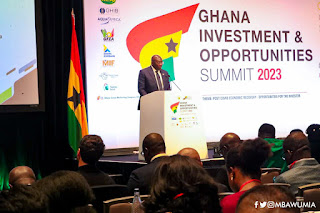
Ghana is back on track with investment opportunities - Veep woos foreign investors

Accra, June 6, GNA-Vice President Mahamudu Bawumia says Ghana's economic opportunities for private sector investors are back on track as...