5.11.06

Honour commitment to opening market and debt relief for Africa- Summit


The Beijing Summit of the Forum on China-Africa Co-operation ended on Sunday with a call on the international community to encourage and support Africa's efforts to pursue the path of peace and development.


In addition, the Summit demanded an increase of the official development assistance from developed nations and asked that they honoured their commitment of opening their markets and debt relief to enhance the continent's capacity in poverty reduction.


These were contained in a declaration adopted by the leaders and read out in parts, by Ethiopian Prime Minister, Mr Meles Zenawi, Egyptian President Mohammed Hosni Mubarak and Chinese President, Mr Hu Jintao.

President John Agyekum Kufuor was among the 41 African Heads of States and Governments, who attended the two-day meeting which, was aimed at charting a new course in Africa-China economic and trade relations.

The leaders re-affirmed their adherence to the one country-region on China's policy and support for country-region on China's peaceful reunification.
It noted China's peaceful development and the commitment to place Africa, a continent with the largest number of developing countries on the paths to stability, development and renaissance, which were in themselves significant to world peace and progress.


China and African countries should therefore, enhance their traditional friendship and expand mutually beneficial co-operation to achieve common development and prosperity in view of their shared development goals and converging interests.


“We propose to enhance South-South co-operation and North-South dialogue to promote balanced, coordinated and sustainable development of the global economy to enable all countries to share its benefits and realize common development and prosperity.

“We hold that the United Nations (UN) should strengthen its role through reform, pay greater attention to the issue of development and give priority to increasing the representation of African countries in UN agencies,” the Summit declared.
GNA

3.11.06

Give students free condoms – MP


Mr. Charles Hodogbey, MP for North Tongu on Friday suggested that government makes condoms available to students from the Junior Secondary School to the University levels to check the spread of HIV/AIDS.

Recalling his days of community work in Chicago, USA, Mr Hodogbey said condoms could be placed at vantage points in the schools campuses where students could have free access to them.

Mr. Hodogbey made the suggestion in a contribution in Parliament on a statement by Mrs. Gifty Eugenia Kusi, MP for Tarkwa Nsuaem on "HIV/AIDS and Poverty- the African Woman's Bane.

Mrs. Kusi had said in the statement that poverty was pushing young women on the African Continent to indulge in illicit activities such as prostitution for sustenance, and in the process exposed them to all sorts of sexually transmitted diseases, including HIV/AIDS.

Mrs. Kusi said there was a rise in HIVAIDS cases, and said at a recent Commonwealth Women's Parliament seminar on Women's Health, Poverty and HIV/AIDS, seminar, the women fought for the cause to intensify the education of the Ghanaian populace and fellow MP's on the dangers and effects of the pandemic.

She also noted that maternal mortality rates had been aggravated by the high incidence of HIV/AIDS, and recommended that the Ghana Health Service come out with a policy or legislation to make maternal death one of the notifiable events.


Mr Hodogbey in his contribution supported a mandatory test for HIV/AIDS for people entering into marriage, establishment of a research institution, and a dedicated HIV/AIDS clinic.

Ms Akua Sena Dansua urged men to be more interested in discussing issues on women that dealt with HIV/AIDS. She regretted that even men in Parliament were not so keen in taking part in discussion on the subject.

Ms Cecilia Obeng Dapaah, Deputy Minister for Water Resources, Works and Housing, called for sympathy and good for people living with AIDS, adding, " Your infected wife or husband who has HIV/AIDS, is a still your husband or wife; your son or daughter who has HIV/ AIDS is still your child."
GNA

Kwabena Agyepong is out and about.

Mr Kwabena Agyepong, former press secretary to President John Agyekum Kufuor, and currently a presidential aspirant in the camp of the New Patriotic Party (NPP), has embarked on a five-day tour of the Volta Region as part of his campaign to outline his vision and canvass for votes in the 22 constituencies whose delegates would be voting at the Party’s primary.

In an interview with the Ghana News Agency (GNA) after meeting the Akan constituency executive at Kadjebi, Mr Agyepong said he felt very strengthened and energized at the remarkable support and encouragement he received from the party's dedicated and selfless foot soldiers.

He pointed out that the hallmark of his political programme was to pursue the interest, and aspirations of the youth and women, adding that, "the welfare of the individual and the state is the essence of politics".

Mr Agyepong said the Kadjebi constituency executive should be proud to be associated with the achievements of the NPP government under President J.A. Kufuor and appealed to them to trumpet the success story in their communities.

He said there was need to fast-track the interventions that had already been put in place to support indigenous entrepreneurs with long term risk capital. Mr Agyepong said what the NPP needed was a decisive and vibrant leadership, adding that he possessed such qualities.

He said he would inject peace, passion and patriotism into the body politic if given the mandate to lead in 2008.

"As a team builder, I would work hard to harness the nation's human and natural resources and marshal the socio-economic development of the country to a new level by building on the considerable achievements of the NPP's two term achievements.
GNA

Netherlands to help Ghana manage environmental problems

Ms Lidi Remmelzwaal, the Netherlands Ambassador to Ghana on Friday said her country would support Ghana to solve her environmental problem to ensure the livelihood of Ghanaians.

She said initiatives like marine and coastal ecosystems needed to be improved to ensure sustainability and good health. Ms Remmelzwaal was interacting with Mr Stephen Asamoah Boateng, Minister of Local Government, Rural Development and Environment, when she called at his office to formerly introduce herself as the new Netherlands Ambassador to Ghana and to discuss ways to improve cooperation.


She said other initiatives her Government would undertake in Ghana include assistance to develop the private sector, as well as improve on education and enhance growth.


She said local governance through the decentralization process was important to enhancing Ghana's democracy and to enable the people at the grassroots to participate and manage resources at their disposal.


Ms Remmelzwaal said she considered herself lucky to be posted to Ghana, which was doing considerably well in the Sub-region, and that she would build upon the work of her predecessor, who had since been posted to Abuja, Nigeria, to deepen cooperation.


Mr Asamoah Boateng said it had been his objective to ensure that the livelihood of the people were protected by ensuring that river bodies and the sea were not polluted through the deposit of toxic wastes.


He said the cardinal principle of the Ministry was to put the welfare of Ghanaians at the centre of service delivery, adding he was looking forward to giving a good performance account of his Ministry at the end of his tenure.


He said there was need for the people to handle local administration for their own benefit and also to indirectly participate in the decision making process.


Mr Asamoah Boateng expressed appreciation for the Netherlands assistance to Ghana’s decentralization process and said the government would continue to learn from that country’s developmental agenda.


He also lauded the Netherlands for its contribution to the Ghana's school feeding programme, adding that some reviews had been done in the pilot stage and would be implemented on a larger scale to achieve the objectives of the programme.
GNA

NIDs entres second day, shortage of ITNs recorded in Greater Accra

The Integrated Child Health Campaign aimed at reducing under-five mortality rate by two-thirds by the year 2015 entered its second day on Thursday with some parts of Greater Accra experiencing shortage of Insecticide Treated Nets (ITNs).

The five-day campaign, combining measles and polio immunisation, administering of vitamin A and distribution of 2.1 million free ITNs to children less than two years is expected to boost the survival rate of millions of children.

A visit to the some parts of the Tema sub-districts revealed that many mothers have been attracted to the exercise because of the distribution of free ITNs.
At the Ashalley Botwe Newtown post, mothers started queuing as early as 0430 hours to be served early.

Ms Emefa Voudianyi, a volunteer, said the first day registered over 300 children and 300 ITNs were issued out. However, they could not immunize all
the children in the queue because their number.

She said the post had only three volunteers without a nurse and they had
to hire a nurse from a private midwifery centre nearby to give out the measles injections.

She explained that the nurse assigned to the post did not turn up and “going to look for another nurse delayed the start of the exercise and that created a little confusion”. Ms Voudianyi said the post received only 100 ITNs for Thursday’s exercise and said this had forced them to issue to ITNs to only children from zero to
16 months.

“We know this will create another problem because mothers with eligible children who will not be given the ITNs will not be happy with our decision,” she added.
Mrs Eunice Bekoe, a mother, said she was dissatisfied with how the
exercise was going, especially the delay in attending to them.


“I am a working mother and I came to join the queue as early as 0500
hours with the hope that I will be attended to in time so that I could go to work but it is past 0900 hours and I am still in the queue.” At the Adjirigano post, near East Legon, over 200 children had been immunized as at 1110 hours when the GNA visited the post.


Mrs Rose Agble, Tema Rural Coordinator, told the GNA that the nine immunization points under her had all run out of ITNs but they had enough vaccines. She explained that she was given only 30 sacks of ITNs instead of 1,000 sacks since she had about 15,000 children in her district.


“The ITNs have attracted a lot of mothers and that has increased the
number we estimated. Yesterday was bad and it called for the involvement of
the East Legon Police to control the crowd that had come to immunize their children,” she said.

The situation was different at the Adenta Housing Down, Adenta Clinic
and Ogbojo when the GNA visited. Dr Kwadwo Antwi Agyei, Programme Manager for the Expanded Immunisation Programme of the Ghana Health Service, told the GNA that the shortage of ITNs in Greater Accra was due to the fact the region received its allocation of the ITNs this week and distribution was still underway.

“We have enough ITNs for the whole country and the problem of shortage should not occur,” he said.Dr Antwi Agyei noted that various immunisation posts had been issued with coupons to be given to eligible children who would not readily get the ITNs for them to be served immediately the various points had been restocked.

The exercise nationally is expected to target about 5.959 million children from 0 to 59 months for polio and about 5.065 million children from nine months to 59 months for measles. The exercise with cost about 162 billion cedis. There are 9,050 immunisation points, 9,505 vaccinators and 28,514 volunteers to ensure that all the children are covered.

Online News Widely Accepted as Credible

By Howard I. Finberg

Credibility. It is hard to define, hard to earn, and even harder to regain once it is lost.For decades, news organizations -- especially newspapers -- have struggled to understand why readers find the media less and less credible.

Or why some news organizations, such as cable news networks, have a higher credibility rating than older and more established (and local) news outlets. It is a vexing problem.


The task grew even more complicated eight years ago when the Internet offered the public a whole new, interactive way to obtain news and information. A question that may plague us for the next several decades is, "How do the issues of credibility and reliability play out in the online news environment?"


Media consultant Martha Stone and I have been studying digital journalism credibility for the past year on behalf of the Online News Association. Our report, which was released Jan. 31, is based on more than 50 interviews with industry executives, dozens of case studies, several industry roundtables, and two research surveys.

The ONA study, which was funded by a grant from the John S. and James L. Knight Foundation, also outlines strategies that several sites have undertaken to be more open and more transparent with their readership.


We found that the public has largely accepted digital news as an important source of credible news. Thirteen percent of the online public saying that Internet news is their most trusted source of news.


However, the ONA survey also shows that most of the online public surveyed remains neutral on credibility issues surrounding online news.


This lack of strong opinion is where the online news media may have its greatest opportunity. It is a chance to move those neutral views to positive ground. Or, conversely, there is the real danger that the public will be come critical of some practices and become as critical of online news as it is of newspapers.


The acceptance of online news is good news for digital journalists. Although the older, traditional media has been losing the public's trust, online news seems to be enjoying a credibility honeymoon, according to a national survey of 1,000 online consumers and 1,500 media workers conducted for ONA.


Rather than vilifying digital news, the online public has largely accepted it as an important source of credible news. Journalists surveyed expected the public to be much more negative about the credibility of digital news. They also expressed more concerns about professional quality than the online public.


The survey also indicates there appears to be a division of opinion about the credibility of digital news between those who work for traditional media organizations -- newspapers, broadcasting -- and those who work for Web sites. And there is a difference of opinion about credibility between the media workers who took the survey and the online public. Some examples from the report:


* Media workers were more likely to have made up their minds about credibility and were more likely to be critical than the online public was. Among the rankings produced by the survey's media respondents, there were five sources (local TV news, local radio stations, other news Web sites, local TV Web sites and local radio Web sites) about which more than 25 percent - and as many as 40 percent - say the source is not credible. By comparison, no more than 12 percent of the public says any particular news source is not credible.

* When asked to agree or disagree with the statement: "Online news sites are my/consumers' most trusted sources for news," 13 percent of the online public agreed, 44 percent had no opinion, and 43 percent disagreed. Media respondents predicted that 79 percent of online readers would disagree with the statement.


The report's executive summary puts the gap in perception between media and public this way: ". (the) survey's findings should prompt journalists and the public alike to confront a critical issue: Is there something the media perceives or knows about the ethics and practices of online news organizations or operations that the public does not know? Or are traditional media just being resistant to online news?"


The report also examined the reasons consumers use news Web sites and the most important factors affecting story credibility. Some highlights include:


* When it comes to credibility, online readers are more concerned about accuracy than timeliness. In a list of 11 story characteristics affecting credibility, online readers rank "story is up to date" fifth, after accuracy, completeness, fairness and trusted source.


* Asked directly if the separation between advertising and editorial content matters to a news source's credibility, the public overwhelmingly (95.9 percent) says "Yes, it matters." But when ONA asked online readers to rank advertising-editorial independence as a variable affecting news credibility, it barely made the list (ninth of 11 attributes, ahead of audio/visual quality and entertainment value).


* About 40 percent of the online public are confident they can discriminate between advertising and editorial content, with another 30 percent expressing neutrality or a lack of opinion on the issue. That confidence is positively correlated with a reader's general trust of online news, which increases in time spent online and with the number of times a reader has visited a particular online news site. Familiarity breeds confidence.


The issue of advertising and editorial separation has been a hot discussion topic among online and traditional journalists. The findings about the separation of advertising and editorial content should be reassuring to those site managers who are trying to find new ways of attracting revenue. However, it might be too early to relax about this finding, as poorly labeled content could have a negative affect in the long run.


In addition to the results of its two surveys, the ONA's Digital Journalism Credibility Study presents a broader discussion of the professional experiences and insights. Among the topics covered are:


* Who is a journalist? This includes a discussion on journalistic training and experience.
* What kinds of challenges to credibility have downsizing, reorganization and retrenchment posed?
* What kinds of training or professional perspectives should media workers in online newsrooms be expected to have - practically and ideally? Technical issues have typically taken precedence over ethical concerns when it comes to newsroom training, but that may be changing in online newsrooms.


* How are online newsrooms working through the challenges presented by the pressures to produce revenue? The report sites specific ways in which various news organizations are dealing with sponsored content and presents an in-depth discussion of advertising policies and processes.


* How are online newsrooms handling the Web's two hallmark characteristics: immediacy and interactivity? While the push to get the story first remains very much a part of the online news industry culture, there's a clear recognition that getting it first is not as important as getting it right. Brand credibility is at stake.


The issue of digital journalism credibility is broad and deep. The ONA study is a first look at many of the issues journalists -- print, broadcast, online -- will need to address if we are to take advantage of this new medium that allows almost instant publishing, unparalleled depth of content, and unique interactivity with readers.


Just as developing online news medium continues to be an exciting challenge, so should the opportunity to secure and increase the medium's credibility with its readers.

2.11.06

President Kufuor arrives in Beijing for China-Africa Summit

President John Agyekum Kufuor on Thursday arrived in the Chinese capital Beijing, to attend the China-Africa Heads ofState Summit, to define the investment and trade relations between Africa and China, an emerging global economic giant, in the coming years.

About 48 African Heads of State and Governments are expected to take part in the meeting, said to be the largest ever to be held in that country and which, gets underway from Friday, November 3-5.

Trade between China and Africa stood at 50 billion dollars last year.
The meeting would take a critical look back at the friendship between the continent and China and devise a blueprint for future partnerships, to bring about broader prospects of development.

President Kufuor, accompanied by Nana Addo Dankwah Akufo-Addo, the Foreign Minister, Mr Joseph Adda, Minister of Energy, and other senior Government Officials were met on arrival at the Beijing International Airport, by high ranking Chinese Officials.

The President would seek, during the meeting to convince China for a development support of 1.2 billion dollars to fund the Bui Dam project, rural electrification and the improvement of Ghana’s telecommunication system.

He is scheduled to hold separate bilateral talks with Chinese President Hu Jintao, and Premier Wen Jiabao, as well as meet with Sino Hydro Corporation on the Bui Dam Project.
His other engagements would include meetings with Huawei Technologies Company Limited over Ghana’s Internet backbone and E-Government Project and the ZTE Corporation on the GOTA Security System Project.

Relations between China and Ghana, which dates back to 1960 has always been good but was taken to a new level following a state visit to that country by President Kufuor in 2002.

During that visit, China agreed to a 30 million dollar interest free loan for the construction of the 17.4 kilometre dual carriageway of the Ofankor-Nsawam section of the Accra-Kumasi Highway.

Additionally, it wrote off 83 million dollars of debt owed her by Ghana, while ACATEL Shanghai of China put in an investment of 150 million dollars in the Ghana Telecom.

Besides, China has also been supporting the construction of military and police barracks in Ghana, with trade between the two countries hitting an all time record of 769 million dollars last year.
GNA

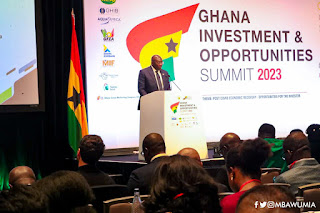
Ghana is back on track with investment opportunities - Veep woos foreign investors

Accra, June 6, GNA-Vice President Mahamudu Bawumia says Ghana's economic opportunities for private sector investors are back on track as...