30.7.07

Parliament rejects President’s nominee, freezes two


Parliament has rejected the nomination of Rev. Dr Akwasi Owusu-Bi as Deputy Minister of Trade, Industry, Private Sector Development and PSI.The House has also deferred until further notice the approval of Mr Kenwood Nuworsu as Deputy Minister of Manpower Youth and Employment and Ms. Victoria Bright as Deputy Minister at the office of the President.The House took the decisions after the Chairman of the Appointments Committee of Parliament; Freddie Blay had moved a motion for the approval of the last 14 Ministerial nominees who were vetted by the Appointments Committee of Parliament last week.The other 11 nominees were however approved unanimously by the House making the total number of approved nominees 23.The rejection of Rev. Dr Akwasi Owusu-Bi’s nomination was based on inconsistent answers he provided to some questions which were asked by the Appointments Committee while the deferment of the nominations of Mr Kenwood Nuworsu and Ms Victoria Bright was aimed at giving the Appointments Committee more time to investigate some issues about the nominees. Hon. Freddie Blay, Chairman of the Appointments Committee described the decision of the House as an evidence of deepening democracy in the country.Parliament rises on Tuesday, and so resumed sitting today in a bid to complete the task of approving the President's nominees for ministerial jobs. The Appointments committee is expected to present its report to the House for consideration today. The Committee sat last Saturday to complete vetting of three nominees; Frank Agyekum for deputy Information Minister, Frederick Opare Ansah for deputy Communications Minister and Maxwell Kofi Jumah for deputy Local Government, Rural Development and Environment.

29.7.07

Nuclear is way out

A committee of experts set up to plot the way out of Ghana's prevailing energy crisis has identified nuclear as the only long-term option. It has, therefore, called for immediate steps to be taken in pursuit of nuclear energy as an alternative source of power. The advice formed part of the recommendations of the committee set up by the President to consider the possibility of Ghana adopting nuclear as a long-term source of power. A source at the committee said that its members felt that Ghana had no choice but to opt for nuclear, since hydro and thermal energy could not provide the required mix needed by the country. Besides, it said, hydro and thermal energy were fraught with natural and operational difficulties from which the current energy crisis resulted. According to the source, members of the committee, chaired by the Chairman of the Council of State, Prof Daniel Adzei-Bekoe, noted that globally countries were opting for nuclear energy as an alternative source of power and cited France, where nuclear energy provided 80 per cent of that country's power, as an example. It said the committee, which would present its report to the President within a month, was now considering the types of reactors to use and where they should be placed. The source said members of the committee were also considering the means of financing the project. The committee was also looking into the legislation guiding the setting up of nuclear plants, it said, adding that "members of the committee are carefully planning" to ensure a smooth take-off. The source said building a nuclear plant was expensive but the cost of operating it was less than that of operating a hydro or thermal power generating system. Besides, it said, nuclear energy could serve as a source of revenue for the nation, since many countries in the West African sub-region lacked electricity. Asked whether Ghana had the financial wherewithal to operate nuclear plants, the source answered in the affirmative. On expertise, it said a core group of scientists could be trained to man the plants, since they would take between eight and nine years to start operations.It said the country could also seek advice and support from the Interna¬tional Atomic Energy Agency (IAEA); In a related development, the Ghana Atomic Energy Commission (GAEC), in collaboration with the IAEA, has developed an integrated nuclear security support plan for the country.Consequently, experts from the !AEA are in the country to discuss the plan with the GAEC on how to implement it. The plan, among other things, seeks to protect the people and the environment from any radiological accident. The acting Director for Radiation Protection Board of the GAEC, Prof Geoffrey Ami-Reynolds, said this in an interview in Accra yesterday. Source: Daily Graphic

28.7.07

Mystery Illness among Global Resources Ghana Staff?


Fifteen colleagues of an oil services worker who died in Ghana are to be flown home.But Global Resources played down claims of a mystery illness among staff in Ghana after the death of pipe fitter Keith McKintosh, from the Black Isle in Ross-shire.The firm's chief executive Paul Wisely confirmed that some staff had complained of "minor" illnesses but said they did not appear to be related.They are to return to Britain after requesting to do so on compassionate grounds after the death of Mr McKintosh.None had "initially" requested to come home due to concerns about illness among the staff, Mr Wisely said."There have been a number of employees who have reported minor ailments, but there is no common thread to them," he said."These have ranged from sunburn and stomach ailments to mild malarial symptoms. Medical facilities and medical support are provided, and no Global employees were transported home from Ghana due to illness."He added that the cause of Mr McKintosh's death was still under investigation. "We expect to hear the results of the post-mortem soon," he said.His body will be repatriated as soon as possible, and a senior member of the company's management team has arrived in Ghana to offer support.Nine men will fly out of Ghana over the weekend. One has already flown home and flights have been arranged out of Ghana for the remaining five employees. The firm said a "significant number" of staff remained in Ghana.
Source:GHP

Corruption seems to Like the Kuffour Family

Newly unsealed documents in the United States federal bribery case against Rep. William Jefferson, D-New Orleans, describe a plan to steer profits to the son of the president of Ghana and a frantic effort to get the congressman to revive a lucrative deal in Nigeria as it appeared to unravel.
The newly available documents shed light on a telecommunications deal prosecutors say Jefferson was orchestrating in Ghana. They allege that Eddie Kufuor, son of Ghana President John Agyekum Kufuor, was to push the deal inside the government.
"Jefferson has told (the confidential witness) that is it likely the son of the president of Ghana will receive a share of the profits of a joint venture to be set up in that country in exchange for his assistance in obtaining the necessary approvals for the commencement of the business venture there," the FBI wrote in its search warrant application to search Jefferson's New Orleans home and the office of accountant Jack Swetland. Swetland has not been charged.
The documents show that Eddie Kufuor was one of those who traveled from Washington with Jefferson to Ghana, where the deal was pitched to numerous high-level government officials including the vice president and the minister of communications. Kufuor could not be reached for comment Friday.
The papers also state that Jefferson stored some of the of money he took from an FBI informant in soy burger boxes and other food containers in the freezer his Capitol Hill home.
For nearly two years, the Justice Department resisted legal efforts by The Times-Picayune and The Washington Post to open the records of what the FBI found when it searched Jefferson's homes in Washington and New Orleans, his car and the office of his accountant. Last week, more than a month after Jefferson was indicted by a federal grand jury, the government relented, and the documents were available for inspection Friday.
They contain no major revelations in a case that first burst into public view Aug. 4, 2005, when the FBI served its search warrants in a case that centers on Jefferson's efforts to help land African contracts for iGate Inc., a U.S. telecommunications firm. In June, the government indicted Jefferson on 16 counts of racketeering, bribery, fraud and obstruction of justice. He pleaded innocent and has vowed to clear his name in a trial scheduled for early next year.
The documents fill in some of the blanks in the story of how the government thinks Jefferson sought to profit from the African deals and how investigators see him as a central player in engineering the ventures.
The government alleges that Jefferson received more than $400,000 in bribes and millions of shares of corporate stock for helping iGate gain a foothold in Nigeria and Ghana. By 2005, it appeared that Jefferson had persuaded NITEL, the Nigerian state-owned telecommunications company, to use iGate's high-speed Internet technology, a deal he estimated would be worth $200 million or more.
But in June of that year, according to the documents, the deal appeared to be falling apart. NITEL purchased Chinese telecommunications supplies incompatible with iGate's technology. Wiretaps placed by the FBI overheard businessman Suleiman YahYah, who was the Nigerian contact with NITEL, urge iGate CEO Vernon Jackson to get Jefferson involved, the government said.
"The solution to the problem rested with Congressman Jefferson," the government wrote in its search warrant affidavit.
When FBI agents raided Jefferson's Capitol Hill home, they found $90,000 in his freezer. The money had been handed to Jefferson days earlier by an FBI informant, and prosecutors have noted that the money was neatly wrapped in aluminum foil.
Documents from that search show that the money was in frozen food boxes.
According to the FBI, Jefferson placed $20,000 wrapped in foil and rubber bands inside a Boca Burger box. Boca is known for its organic soy burgers. Another $20,000 was stashed inside a Pillsbury Pie Crust box.
Three stacks of cash containing $10,000 each were found inside a bag from the local "Yes Organic Market" grocer. Two more cash bricks, a total of $20,000, were found simply wrapped in foil in the freezer.
Around his house and in his 1990 Lincoln Town Car, the FBI found numerous documents related to iGate, Nigeria and the telecommunications deal. On the coffee table of his home, agents were careful to note they found a box of Reynolds Wrap, 200 square feet.
Source:times-picayune

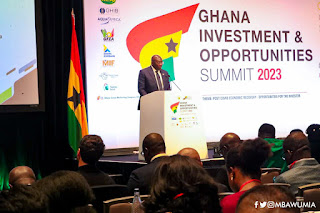
Ghana is back on track with investment opportunities - Veep woos foreign investors

Accra, June 6, GNA-Vice President Mahamudu Bawumia says Ghana's economic opportunities for private sector investors are back on track as...