23.11.06

All 'Cocaine men' to be freed!

The President is planning to undertake one of the most wide-ranging institutional reforms ever carried out, in response to falling confidence in the police service, The Statesman can reveal.
Meanwhile, the prosecutions against the men suspected to be Ghana’s leading drug barons, are crumbling with the police still not being able to support all the charges with evidence that may stand up in a trial.Already, last Fridayan Accra Regional Tribunal chaired by Justice Frank Manu discharged Alhaji Moro and three other suspects, who had been held in connection with the missing 76 parcels of cocaine from the vessel MV Benjamin for want of prosecution. The Prosecution withdrew the case.
While details are still sketchy, a Commission of Enquiry, similar to the Justice Archer Commission, which presented its report in 1981, is apparently being considered.The President is said to prefer an institutional structure that can readily purge the force of abusive and criminal elements.
It could, in an extreme probability, even mean dismissing officers on reasonable suspicion of inappropriate behaviour, a source hinted.The recent Georgina Wood Committee report observed that “a new cadre of security personnel imbued with a high sense of integrity, discipline, nationalism and patriotism is urgently needed for law enforcement in the country.
”Meanwhile, as revealed by The Statesman and The Crusading Guide Tuesday, President John Agyekum, acting on advice from the Police Council and the Attorney General and others, has renewed his confidence in the Inspector General of Police, Patrick Kwarteng.
The shortcomings of the Police have been identified to include corruption, problems with training, management, supervision and excessive use of force. According to a senior Castle source, the President believes the “major focus must be on reforming the institution, tackling the corruption, indiscipline, institutional disregard for basic human rights, and the administrative weaknesses nationwide.”
The source summed the expectations as thus: “The focus of the reforms is on the wider need to greatly improve policing.”The reforms are expected to involve a wide-ranging shake up of policing structures, which should lead to greater autonomy under a much decentralised force.
Issues to be addressed include implementing revenue-generating measures, such as spot fines, etc, to help boost the running of police services in the districts.Also hinted is a kind of police standards unit, which will ensure that a high and uniformed code of conduct is maintained.Another pressing proposal is to set up an independent police complaints commission to address public grievances against the police.
The complaints body may also be empowered to initially look into cases of police corruption and hand it over to the appropriate institution, such as the Criminal Investigation Division of the Service to look into it, and then give a report to the independent body after investigation.Public confidence in the police is being undermined by corruption, especially road traffic bribery.
But, Government believes, if proper discipline is instilled, fines from traffic offences could serve as a major source of revenue to help enhance the quality of the service.The service currently is struggling to cope with the demands of modern policing, such as complex serious crimes and even the global threat of terrorism.
The reforms will also involve cutting down waste and establishing a much enhanced conditions of service for officers, especially their take-home pay. Public confidence in the police remains low and mobs have attacked several police stations on several occasions. In January the presidential Archer Commission issued a white paper critiquing police operations and providing specific directives as to how to address police manpower, training, and logistical needs.
But, human rights advocates also talk of an apparent blatant disregard for the rule of law and the Constitution ordinarily exhibited by the police service, which the reforms are expected to address, as well.
For example, even though Prince Tsibu Darko, who was facing drug offence charges, was granted bail by an Accra High Court after four months in custody on what Justice A K Abada described Tuesday as on grounds of “mere suspicion”, by last night, the police were still refusing to release him, saying they were awaiting instructions from the Attorney-General in clear contempt of the court order.
Meanwhile, the circuit judge presiding over the drug case against four alleged drug traffickers, was yesterday promoted to the High Court. The suspects, who have also been on remand for four months, are Kwabena “Tagor” Amaning, Abass Issah and Kwabena Acheampong.Information reaching The Statesman suggests that today, Chief State Attorney Gertrude Aikins is likely to file a nolle prosequi – meaning the state is “unwilling to pursue” the case against the accused persons.
The Attorney-General’s Department had earlier told the Circuit Court that it intended to put the suspects before the Fast Track High Court.The three were arrested after testifying at the Justice Georgina Wood Committee, set up by the Ministry of the Interior to investigate two high-profile cocaine cases.
Another suspect, Victor Kisseh, alias Yaw Billa, who was arrested and charged later, has since been freed.
Source:Statesman

Ghana described as a “hybrid regime"

The Economist Intelligence Unit has ranked Ghana 95th in the list of the most democratic states, placing it squarely in what the publication called the “hybrid regime” category. Ghana was placed in the same category with Liberia (98), Uganda (100) Russia (102), Gambia (108) Haiti (109) and Iraq (112).
Countries were divided into four groups: “full democracies,” which received average scores of 8.00-10.00 in some five indicators; “flawed democracies,” which received 6.00 to 7.90; “hybrid regimes,” which received 4.00 to 5.90; and “authoritarian regimes,” which received scores below 4.00.
Ghana’s overall score was 5.35 out of 10.00, and it placed 13 slots away from being a “flawed democracy.” Broken down by category, it scored relatively well in terms of its electoral process and pluralism (7.42). But the average was brought down by its mediocre performance in Civil liberties (5.88) and the poor performance in the functioning of its government (4.64), political culture (4.38) and political participation (4.44) sectors.
Scandinavian countries Sweden and Iceland took numbers one and two respectively, followed by the Netherlands, Norway, Denmark, and Finland.
The U.S. at 17th, and U.K., 23rd, ranked in the bottom half of the full democracies, which the article attributes to the erosion of the civil liberties as a function of the War on Terror. Italy, a member of the Group of Seven industrialized nations, ranks as a ``flawed'' democracy
No African states among the top 28 nations was characterized as “full democracies”. South Africa, Botwana, Cape Verde, Namibia, Lesotho and Mali were among the “flawed democracies”
All of Ghana’s neighbors fell within the “authoritarian regimes” group: Burkina Faso was ranked 119th, Ivory Coast 127 and Togo edged in at the bottom of the category in the 164th spot. Nigeria also fell in the same category placed 124th
The article published in The Economist’s "World in 2007" surveyed 167 nations and ranked them according to its own democracy index, a measure that incorporates “electoral process and pluralism; civil liberties; the functioning of government; political participation; and political culture.”
The Economist’s index was an attempt to thicken the definition of “democracy” set forth by the world’s preeminent democracy-ranking organization, U.S.-based Freedom House. That organization bases its rankings mostly on institutional requirements for electoral democracy: the components of free and fair competitive elections. The Economist’s democracy index includes a variety of other factors that the publication claims provides a more complete definition.
According to the report, 13 percent of the world’s population lives in “full democracies,” 32.3 percent live in “flawed democracies,” 10.5 percent live in “hybrid regimes,” and 38.2 percent lives in “authoritarian regimes.”
The following is a table of the six most democratic nations according to the Economist's ranking, and selected other nations, along with their score (from 1 to 10) Rank Country Score 1. Sweden 9.88
2. Iceland 9.71
3. Netherlands 9.66
4. Norway 9.55
5. Denmark 9.52
6. Finland 9.25 1
7. U.S. 8.22 23. U.K. 8.08 2
9. South Africa 7.91
34. Italy 7.73
80. Mali 5.99
95. Ghana
102. Russia 5.02
112. Iraq 4.01
124 Nigeria 3.52
138. China 2.97
167. North Korea 1.03

22.11.06

30.7m Euro EU grant for Kumasi-Techiman road

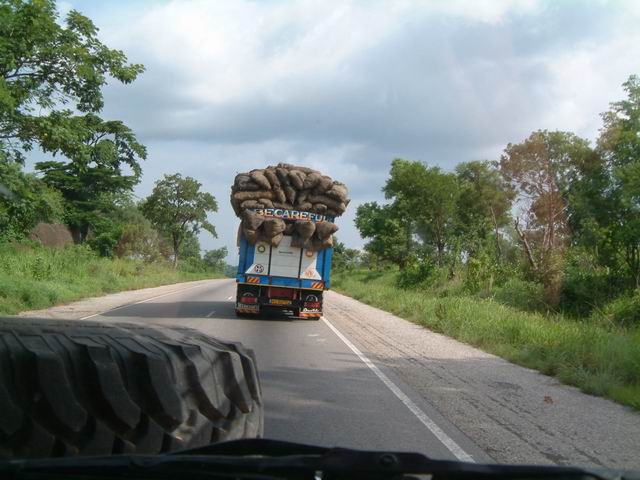
Government on Wednesday signed a 30.7 million euro grant agreement with the European Union (EU) for the rehabilitation of the Kumasi - Techiman road. The amount would be used to rehabilitate the second phase of the Kumasi-Techiman road covering about 75 kilometres, which would include 2.1 kilometres of dual-carriage.
The first phase of the project, which is schedule to be completed in May 2007, covered a stretch of 40 kilometres. Signing the agreement on behalf of the Government in Accra, Mr Kwadwo Baah-Wiredu, Minister of Finance and Economic Planning, said the completion of the road would help to improve the connectivity of trade both internally and externally.
"The improvement of the road would impact positively on the national economy and also contribute immensely to Ghana's regional integration efforts" he said. Mr Baah-Wiredu said the 10th European Development Fund (EDF) country support paper for the 2008-2013 would also focus on transport infrastructure development to achieve greater regional integration and promote intra-regional trade.
He said the development of road transport continued to be a focal area of Ghana's cooperation with the EU, which was consistent with Ghana's development agenda under the Growth and Poverty Reduction Strategy II (GPRS II). Mr Baah-Wiredu urged Messrs MSF/SOECO, contractors of the project, to speed up work in order to complete it on time.
Mr Filiberto Ceriani Sebregondi, EU's Ambassador to Ghana, said a Transport Integration Plan would be prepared in 2007 to identify policy measures and action plan with financing strategy to help to boost Ghana's economic growth and poverty reduction. Mr Sebregondi said the transport and infrastructure sector would remain the centre of future support by the EU to Ghana to support growth and poverty reduction.GNA

Human Rights abuses in mining communities disquiet UN Commissioner

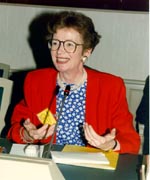
Ms Mary Robinson, Commissioner of UN Human Rights Commission, on Wednesday expressed concern about reports of human rights abuses perpetrated by mining companies in the country.
Speaking at meeting with advocacy groups in Accra hosted by Wassa Association of Communities Affected by Mining (WACAM) and Britain’s Oxfam, both nongovernmental organisations, Ms Robinson said she was deeply concerned by the information she had received regarding the range and severity of human rights problems that continued to affect the mining sector of the country.
“First of all, the level of compensation offered is manifestly unfair. To offer nine dollars to a farmer to buy out a cocoa tree worth at least 20 dollars per year over the tree's economic life of 30 to 50 years is not acceptable. “In a number of cases, security forces working around mine sites have used violent methods to displace community members from mining areas.
“In other cases, mining companies' destruction of communities' water and land resources constitute a violation of communities' right to maintain a sustainable livelihood,” she said. She observed that mining was now Ghana's most important economic sector and said if mining were to contribute to poverty reduction and sustainable development in the country, these critical human rights issues must be addressed.
Ms Robinson, who is a Former President of Ireland, urged the Government of Ghana, as a stakeholder in each mining company, to adopt and enforce regulations to protect the rights of communities in mining areas. “The Government should also thoroughly investigate complaints of human rights violations related to mining and hold those responsible accountable.” She said: “Mining companies must also act to ensure that they are in no way complicit in human rights violations.
At a minimum, this should include ensuring that they do not employ known human rights violators to provide security at mine sites. “They must also avoid contaminating the environment and negatively impacting the resources local communities depend on for their agriculturally-based livelihoods. “Companies should allow independent third-party audits of their compliance with these basic human rights principles.
They should also commit to establishing mechanisms for ongoing independent monitoring of their operations. Such mechanisms should include the participation of local community members, Ms Robinson said.
Representatives of WACAM; Oxfam; Green Earth Organisation; Centre for Public Interest Law; Federation of Environmental Journalists; Youth for Action Ghana; Foodfirst International, Action Network and Media Centre for Youth Development, all advocacy nongovernmental organisations, attended the meeting.
Ms Robinson, who is also the Honorary President of Oxfam International and the Founder and President of Realizing Rights: The Ethical Globalization Initiative, is in Ghana to participate in the UN Global Compact Learning Forum. At the Forum, companies such as Newmont, AngloGold Ashanti and Golden Star Resources, all gold mining companies, would discuss efforts to examine their core business operations in the light of human rights issues.GNA

Farmers' Day declared holiday

The Ministry of the Interior on Wednesday declared Friday, December 1, which is National Farmers' Day a statutory public holiday.


A statement signed by Mr Albert Kan-Dapaah said the day should be observed as such throughout the country.

580 communities to get electricity soon

About 500,000 people in 580 deprived communities in the country would be connected to the National Electricity Grid with a China concessionary loan facility with a grant element of 39.1 per cent.The loan, which has an interest rate of 2.13 per cent; a grace period of four years; 11 years repayment period and 15 years maturity date, would enable China International Water and Electric Corporation to execute the contract under the Government's Self-Help Electrification Programme (SHEP).
Signing the contract agreement in Accra with the Corporation, Mr Joseph Adda Minister of Energy, gave the total cost of the Project as 90 million euros.The Government of Ghana is to contribute the remaining 10 per cent of the contract sum.
Mr Adda said given the current spate of growth in the demand for electricity, the project was timely and would help tremendously to reach those un-reached communities to enable them to fight poverty.
He said the Corporation's track record was good and work would be done, adding that the Government was putting in short term measures to address the current energy problem but noted that it was also important for consumers of power to also start thinking to learn how to use energy wisely for the benefit of all.
Some of the measures include the installation of several thermal power plants projects especially in Tema to generate at least 1,000 megawatts of power next year.Mr Kwadwo Baah-Wiredu, Minister of Finance and Economic Planning, who signed the contract on behalf of the Government, said under the SHEP programme a beneficiary community must be within 20 kilometre-radius of an existing 11/33 Kilovolts network.
SHEP which begun 16 years ago formed part of the National Electrification Scheme (NES) which have so far connected about 4,000 communities Access to electricity in Ghana had grown from about 15 per cent of the population at the inception of the national electrification programme to the current level of 55 per cent.
Mr Wang, Vice President of the China International Water and Electric Corporation, who signed on behalf of the Corporation, said the concessionary facility was premised on Ghana's efforts towards reducing poverty and the fact that the country was doing well in its economic advancements.
Source:GNA

Street-naming, house-numbering project begins


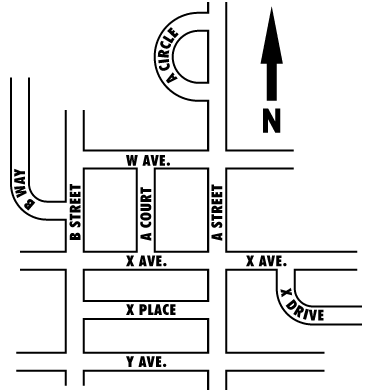
With ¢60 billion allocated in this year's budget for the process of street naming and house numbering, the prospect of a properly-ordered address system in Ghana is finally becoming a reality.Already, the first pilot schemes are underway - with streets in the Asante Akim North District of the Ashanti Region sounding more like the avenues and streets of New York – 22nd Street, 4th Avenue, etc.
Explaining to The Statesman, the Finance Minister and Member of Parliament for Asante Akim North said it was decided to use numbers to avoid the controversy of whose name to include and whose to leave out.
Linked to this street naming and house numbering exercise is the ongoing National Identification Card registration process, and an initiative to re-evaluate private properties nationwide."It is a holistic approach to move the nation from a cash-based economy to the more expansive and flexible modern system of a credit-based economy,” explained Kwadwo Baah-Wiredu, in an interview with The Statesman.
Eventually, every town and city in the country will join the exercise, being divided into clearly demarcated roads and properties which can be identified on a map and people who can be identified by a fixed place of abode and not by a post office box.
The scheme is expected to bring order to Ghana"s development, to aid with future town planning and to improve Ghana’s administrative machinery.Speaking to this paper yesterday, the Minister directly in charge of the street-naming and house-numbering project, Stephen Asamoah-Boateng, said the immediate plan is to extend the exercise to 50 districts selected from all ten regions across the country.
He described it as a joint public-private partnership project, which when completed will greatly boost the revenue-mobilisation capacity of the local authorities.The advantages of the street-naming and house-numbering project, as explained in The Statesman Editorial of today, are enormous, both economically and socially.
The Minister of Local Government, Rural Development & Environment underlined that fact by saying, "It would help our efforts in enforcing law and order, rapidly responding to emergencies, such as robberies and fire outbreaks.
Also, the banks will feel more comfortable lending money to a person with a recognisable house address."He also hinted that after the completion of this project, the local authorities will be in a position to implement a more streamlined model of property rates – which will group properties in particular areas into bands, with each within a band paying a set rate.
Speaking Monday during the road-naming ceremony in Konongo, the District Chief Executive of Asante Akim North, George Kwame Frimpong, said the new road system would also aid the emergency services such as the Fire Service and Police Services in their work, enabling them to more easily identify and locate the scene of an emergency.
The haphazard lay-out of towns and villages across Ghana is likely to be one frustration with the project, however. Mr Frimpong said that in the future, developing communities would have to include access lanes in any development.
"This is very necessary since institutions such as the Fire Service would have to get access to distressed victims on time without any let or hindrance," the DCE said.A clear addressing system will also assist district assemblies in their tax revenue as hitherto unidentified properties will be roped into the tax net, he said. Other benefits include the expansion of a door-to-door postal system in Ghana, and the easier location of businesses.
Mr Frimpong told The Statesman that the pilot project already covers Agogo, Konongo and Odumasi, whilst in areas such as Patriensa, Hwidiem, Dome, Woraso and Duase, work is about 60 percent complete.He said when the pilot street naming project is completed, the Assembly will then go ahead with the house numbering.
He said the assembly is considering inviting members of the public who are interested in having streets named after them to take part in the project.
Source:The Statesman

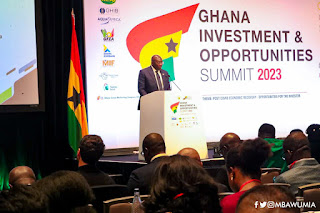
Ghana is back on track with investment opportunities - Veep woos foreign investors

Accra, June 6, GNA-Vice President Mahamudu Bawumia says Ghana's economic opportunities for private sector investors are back on track as...