21.11.06

TMA fails to elect PM after eight rounds of voting in two sittings

After eight rounds of voting in two separate sittings, the 80-member Tema Municipal Assembly (TMA) on Tuesday failed again to elect a Presiding Member because none of the two contestants got the two-thirds majority of the votes cast as the law required.
Despite a series of consultations in the fifth rounds of voting on Tuesday both contestants, Mr Seth Laryea Tetteh, a government appointee and Mr Ibrahim Baidoo, an elected member of Nanmono electoral area and the assembly members took entrenched positions with a status quo voting pattern.
A call on one of them to step down for the other did not yield any results. In all the voting for Tuesday, Mr Laryea Tetteh took the lead with 42 against 32 of Mr Ibrahim in the first round, in the second round Mr Ibrahim's votes reduced by two votes while Mr Tetteh had 47 with two rejects.
Since a contestant needed two thirds of the number or 53 votes to become a winner the voting continued until the eighth round when Mr Laryea Tetteh had 47 and his opponent 27, which was the voting pattern through out the previous voting. Later, tempers flared amidst tension in the House and members took turns to either call for adjournment or conduct fresh nominations as none of the contestants was getting the nod.
But this did not materialize and not even the intervention of the Municipal Chief Executive, Mr David Quaye Annan reminding them that they were accountable to the people and therefore should see the need to vote a PM moved them to change their stance.
Consequently, after lengthy deliberations the election for the PM was adjourned indefinitely at 1530 hours at the sitting, which started at 1100 hrs.
During the three rounds of voting in the first sitting on November 14, two other contestants Mrs Gladys Naadu Tetteh, member for Sutsurunaa electoral area and Mr Kingsley Kwame Appiah, Ottanor electoral area stood down for the other two contestants.GNA

Stop Stealing Cables, MP tells public

Hon. Albert Kwaku Obbin, Member of Parliament (MP) for Prestea/Huni-Valley constituency has warned cable thieves in Bondaye to stop stealing the electric cables, which serves the community.
Mr. Obbin described as an unfortunate the rate at which electric cables were being stolen at Bondaye near Prestea. He has therefore asked the people of Bondaye to serve as watchdogs to protect the electric cables and also help arrest the cable thieves for them to be punished.
He regretted that cables worth more than ¢30m were stolen in the course of rewiring Bondaye lighting system necessitated by the break down of the old transformer. The MP said these at a meeting with Bondaye people to inform them of the completion of the rewiring project and replacement of the old transformer.
The rewiring cost the Electrification Committee 90 million cedis out of which 30 million cedis worth of cables were stolen. On completion of the project, the people of Bondaye would enjoy electricity supply after over 10 months of blackout.
He disclosed that Electricity Company of Ghana would come and take over the transformer, replace the old iron poles with wooden ones and supply meters to households. He said high-tension poles would be purchased to extend electricity from Prestea to Mbeasi Nsuta to hook those communities to the national grid.
Touching on the galamsey issue at Four Bungalow at Prestea, the MP pleaded with the people to stop operating in the aea. He however, said not all those operating there were illegal miners, some were registered small scale miners and therefore seizing their grinding mills was not meaningful and promised to follow up for the release of those machines.
He pleaded with the galamsey operators to exercise restrain to avoid making their case worse because the issue bothers on the survival of the people. Baba Salifu, Electricity Company of Ghana (ECG) Supervisor who was a member of the electrification committee said owing to the expansion of Bondaye community the transformer could not match the required voltage for the community and thus could not supply the needed power.
He pleaded with the people to expose the cable thieves, promising one million cedis reward for those who will give a clue leading to their arrest.GNA

Public Servants to enjoy enhanced salary from January 2007

Come January 2007, all Government workers will see an upward adjustment in their pay compared to the wages and salaries levels that pertained in 2006, Dr Paa Kwesi Nduom, Minister of Public Sector Reform, announced on Tuesday.
Briefing the press on the new salary reforms, Dr Nduom said the Government was undertaking a comprehensive adjustment to make sure that all of its workers were treated equally and at the same time.
Government has projected ¢13.2 trillion cedis for the payment of wages and related expenditure, representing 66 per cent of total discretionary expenditure for 2007.
Dr Nduom said the allocation given in the Budget to wages was arrived at taking into account submissions made by various stakeholders to address the inequalities, adding that negotiations were still being held with others.
"We are doing this to allow the changes envisaged in wage and salary administration time to take effect. We are also doing this to enable us to have ample time to engage in dialogue with the labour unions and other stakeholders over the new Comprehensive Wage and Salary Structure and System," he said.
Dr Nduom said several efforts in the past for a systematic, effective and sustainable National Incomes Policy in Ghana had failed because of ad hoc decisions on pay adjustments resulting in different salary structures within the Public Services. "In some cases, one set of jobs on a particular grade are compensated differently from others even though no critical skills consideration was needed, raising issues of equity," he said.
"Thus there has been deep-seated dissatisfaction among Public Servants about perceived and real inequities in the remuneration of people often with the same qualification and job demands, but receiving very different remuneration packages, depending on the institution where they are employed," Dr Nduom said.
“It is in this direction that the Government is out-dooring a comprehensive and integrated national framework for administering wages and incomes in the public service to ensure that incomes in the national economy are fairly distributed across socio-economic groups, gender and regions and that all categories of workers receive fair reward for their labour.”
Dr Nduom said the Government would take the necessary steps to give legal backing and the necessary technical resources to the Fair Wages Commission, the body to be set up to administer wages across the Public Sector.
The Commission would undertake job evaluation, analyse existing data and job content reviews along with market surveys and other research needed to determine the relative worth of all Public Sector positions. Consequently, a single pay spine would be implemented to cover all positions in the Public Sector making it easier to perform job evaluations and determine the relative worth of every Public sector position.
The result of the work of the Fair Wages Commission would take effect from the 2008 Budget. A technical team had also been set up to do job evaluation, he said, adding that any future salary increments would be based solely on the type of job being performed by Public Servants.
There are also plans to install time systems at the entrance of every Ministry to check those who come late and absentees. Dr Nduom explained that the system would be linked to the Controller and Accountant General so that any Public Servant who was absent from office would lose his salary for the number of days spent away from the office.
Mr Kwadwo Baah-Wiredu, Minister of Finance, said the Government was determined to do its homework and to tackle the wage problem head-on.GNA

Kufuor calls on SSNIT to shift from conserving to investing

President John Agyekum Kufuor on Tuesday asked the Social Security and National Insurance Trust (SSNIT) to open up and venture into strategic and profitable investments to help to grow its capital and the country's economy.
"The grounds are fertile enough to take confident steps into the investment market," he said when inaugurating the 13-member Board of Directors of the Trust under the chairmanship of Mr John Saka Addo, a Former Governor of the Bank of Ghana, at the Castle, Osu.
He mentioned the roads, energy, water, housing and communications sectors, as areas where it could invest as the prospects looked good for higher returns. President Kufuor said SSNIT could do that by going into partnership with those who would come in with the know-how and competence.
Additionally, the Trust should accept the challenge of assisting to empower the private sector to enable it to become more vibrant by using its large equity holdings in the banks to bring them together to support the sector's growth.
Vice President Alhaji Aliu Mahama and some Ministers of State were present at the inauguration, where the new Board members took the Oath of Office and the Oath of Secrecy, administered by the President. President Kufuor suggested to the Board to ensure a revamp of the Trust's Investment Department by engaging crack and competent persons to work in that department, pointing out that similar institutions elsewhere were doing a lot in the areas of social investment, something, SSNIT could also do.
He said he was happy with reports that the Trust was now making prompt payment of pensions and asked that it should continue to build on that to spare pensioners the trauma and pain associated with delayed payment of entitlement. President Kufuor noted that SSNIT was a critical partner of the State and as such it was in the interest of the State that they worked together and consulted on their shared vision to grow the capital of the Trust.
He spoke highly of the outgoing Board for the circumspection and wisdom brought into the administration of the Trust, which has helped to make SSNIT become more solid financially, saying the Board did a very good job. Mr Addo said the Board appreciated the level of confidence the President had in the members and would never betray it.
He said already the outgoing Board had put in place some fundamental policies including placing funds in the banks for on-lending to the private sector; introduction of stakeholders forum where published accounts of the Trust and reports of the Board are openly discussed and the printing of the accounts of all contributors to enable them to keep track of their contributions annually.
He said there were also plans to introduce a scheme that would suit the informal sector to help to mobilise more resources from that sector. The other members of the Board include Dr Rose Karikari Annang, Executive Secretary of the Ghana Employers' Association; Mr Kwasi Adu-Amankwah, General-Secretary of the Trades Union Congress (TUC);
Mr Abraham Tetteh Okine also of the TUC; Alhaji Yakubu Ziblim, Chairman of the Civil Servants' Association; Mr W. Kusi Atansah, Former Chairman of the National Media Commission, and Dr Mahamadu Bawumia, Deputy Governor of the Bank of Ghana. The other members are Dr Anthony Akoto Osei, Deputy Finance Minister; Mr J.K Hackman, Member of Parliament for Gomoa West; Mr T.K. Abubakar Biblazu of the Ministry of Manpower, Youth and Employment; Mrs Gina Ama Blay, Managing Director of Daily Guide; Dr (Nana) E.O.T. Prempeh, Adontenhene of Kumasi Traditional Council and Mr Kwasi Osei, Director-General of SSNIT.GNA

Opening of Canada-funded Peacekeeping Documentation Centre

On Thursday, November 23, 2006 at 09:30 a.m., His Excellency Mr. Donald Bobiash, Acting High Commissioner of Canada, will join the Honourable Mr. Nana Akufo-Addo, Minister of Foreign Affairs, Regional Integration and NEPAD, the Honourable Mr. Albert Kan-Dapaah, Minister of the Interior and Ms. Suzanne Monaghan, President of Canada’s Pearson Peacekeeping Centre to officially open the new Peacekeeping Documentation Centre. This Centre is located at Ghana Police Service Headquarters on Ring Road.

Since civilian police were first deployed to a United Nations peace operations mission in the Congo in the 1960s, their role has evolved substantially. Responsibilities and functions have expanded from monitoring the local police services to include training, mentoring and advising on human rights issues. New police organizations with the ability to respond to the complex challenges of maintaining peace and security in a post-conflict environment have had to be created.

The Peacekeeping Documentation Centre is part of the CAD$3.12 million (approximately 25.161 billion cedis) Canadian International Development Agency- (CIDA) funded West Africa Police Project. Implemented by the Pearson Peacekeeping Centre, the project, begun in February 2005 and due to be completed in March 2007, was created to strengthen West African capacity to provide leadership to civilian police missions within peace operations.
It has involved assessment of capacities of existing sub-regional and national organizations, as well as implementation of recommendations coming out of the assessments. These include development of institutional capacity, review of national police structures for deployment in peace operations, discussions between donors and West African leaders and visits to UN missions.

Among the items supplied by Canada to the Documentation Centre are computer hardware and software, a television, digital video camera, digital projector and screen, and other office equipment.

The establishment of the Peacekeeping Documentation Centre accords with the priorities of the Ghana Police Service. These include the development of facilities to prepare civilian police with the skills required for effective participation in peace support operations. Equipped with computers, resource materials and video equipment, the Centre will also serve researchers and civilians.

Canada’s Pearson Peacekeeping Centre is an international leader in peace operations thinking and learning and supports Canada’s contribution to international peace and security by offering education, training, capacity building and research in all aspects of peace operations. For more information, visit www.peaceoperations.org.

20.11.06

100,000 housing units for workers by end of 2008 - Minister


Mr Hackman Owusu Agyemang, Minister of Water Resources, Works and Housing, on Monday announced that the Government would build 100,000 housing units for workers throughout the country by the end of 2008.
He said the Government had already completed 4,000 houses units within this year and started with the sale of low-cost estate houses in October this year. Mr Owusu Agyemang was speaking at the inauguration of the Ghana Housing Finance Association (GHFA), which aims among other things to broaden housing finance to the low and informal markets through appropriate delivery system.
He said the housing project was part of vigorous effort by the Government to provide affordable houses for workers. He explained that the Government was trying to build the houses at half cost by using local building materials and said an enabling environment to facilitate the work of members of the Association would be created.
Mr Owusu Agyemang said the Government would transform the First Ghana Building Society into a housing bank to enable low-income earners own a house. He advised GHFA to endeavour to bring down rates and simplify issues to help to address the housing problems, saying; "we appreciate the social aspect of the housing system".
Mr Anthony Akoto Osei, Deputy Minister of Finance and Economic Planning, said the Social Security and National Insurance Trust (SSNIT) was assisting real estate developers with 60 million dollars since housing was a priority area of the Government. He noted that housing provided security for everyone hence credit for housing development was for both economic and social progress.
Re-affirming Government's commitment to the housing industry, the Deputy Minister expressed the hope that GHFA would introduce loan products focusing on social transformation in terms of poverty alleviation and urged the GHFA to see housing as an instrument of social and economic development in the face of major challenges posed by population growth and urbanization.
Mr Stephen Asamoah Boateng, Minister of Local Government, Rural Development and Environment, who chaired the function, noted that proper housing management also helped in the identification process.
Mr Asare Akuffo, Interim President of GHFA, expressing the hope that resilience of the economy would be sustained and noted that the capitalist system was all about marketing; and housing should not be left out. "Housing must be seen as a market to develop," he said, and urged the Government to focus on the housing sector.
Mr Akuffo stressed that housing presented an economic opportunity that would share the vision of growth and said GHFA encouraged home ownership. He said the Association shared the Government vision of providing affordable housing as well as broadening housing finance to the low income and informal markets Mr Akuffo pointed out that in situations where developers had to provide off-site infrastructure at high cost was a serious disincentive and constraint to affordable housing.
“There is a chain in the housing market that has important links and it is made up of land and property rights; development finance and infrastructural services; the construction industry and mortgage finance.
Any weak link in the chain constrains development,” he noted. The Ghana Housing Finance Association aims at solving the prevailing problems in the housing finance system by supporting efforts at upgrading informal settlements and slums through public private partnership to foster security of tenure, affordable housing and basic services.GNA

Industries asked to respond positively to incentives in the Budget

The Association of Ghana Industries on Monday asked industrialists to respond positively to the various incentives announced in the 2007 Budget to boost their contribution to the manufacturing sector.


Government last Thursday announced the abolition of the Reconstruction Levy, a cut on duty of imported raw materials to five per cent and removal of taxes on packaging materials for drug manufacturing companies, reduction in excise duties as well as withholding tax among others.


Speaking at the launch of the Sixth Industrial Week Celebration of AGI on Monday, Mr. Tony Oteng-Gyasi, the President of AGI, said members must respond to the government initiative through increased productivity in the manufacturing sector, saying this was necessary to enable the Association make more demand on government to improve the business environment further.


He said development could not be possible without industrialization and pledged the continuous assistance of the AGI to assist in accelerating the country’s economic growth.


Mr Alan Kyeremanten, Minister of Trade, Industry, Private Sector Development and President’s Special Initiatives, who launched the week, said growth in the manufacturing sector must be accelerated four-fold from the current growth rate of four per cent to 16 per cent annually to enable the country attain the middle income status by 2015.


He said industrialization was the main driving force for economic growth and explained why the government made such generous concessions in the 2007 budget to enhance the capacity of the companies to boost production.


Mr. Kyeremanten said government would continue to work with other stakeholders to ensure that factors militating against increased productivity in the industrial sector were removed. He cited the 470 million dollar allocation for resolving the current energy crisis that had hit the country.


Similar efforts are being made in the areas of provision of land banks, industrialised plant and machinery and promoting of raw materials as well as research and development to give the sector the necessary upliftment.


Mr. Asare Akuffo, Managing Director of HFC Bank, who spoke on the influx of foreign banks in the country, said a competitive banking industry was necessary to ensure that banks were effective forces for financial intermediation.


He said the aggressive attitude of the new foreign banks had made some medium sized banks to focus more on customer care.


However, Mr. Akuffo said there was no evidence to suggest that the new foreign banks were ready to compete on price hence the high interest rates still persisted in the industry, adding that the improved lending rate was due more to macro-economic stability noticed in, especially, the falling rate of Treasury Bills and the regulatory changes by Bank of Ghana, such as the abolition of the secondary reserve requirements.


Despite these changes, Mr Akuffo said, high investment cost in deploying technology, high levels of lending risks and lack of credit information had combined to stall the benefits of a more competitive banking environment.


This notwithstanding, he said, Banks were offering borrowing rates below the base rate to good customers, who were ready to share information on their businesses with their banks. He asked the Ghanaian industrialists to seek increase equity participation in their companies to avoid reliance solely on banks for their capitalization.


The Industrial Week is being marked on the theme: Industrial Growth and Challenges of Poverty Reduction.”GNA

Ghana is back on track with investment opportunities - Veep woos foreign investors

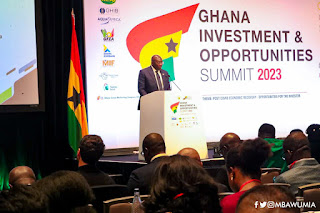
Accra, June 6, GNA-Vice President Mahamudu Bawumia says Ghana's economic opportunities for private sector investors are back on track as...