20.11.06

HP, UNESCO launch joint project to counter brain drain in Africa

Hewlett Packard (HP) and UN Educational, Scientific and Cultural Organisation (UNESCO) on Monday announced the launch of a new project "Piloting Solutions for Reversing Brain Drain into Brain Gain for Africa", which aims to help to reduce brain drain in Africa by providing grid computing technology to universities in Algeria, Ghana, Nigeria, Senegal and Zimbabwe.
A statement from the two organisations received in Accra said the project was launched in Paris. The project aims to re-establish links between researchers, who have stayed in their native countries and those that have left, connecting scientists to international colleagues, research networks and funding opportunities.
It said faculties and students at beneficiary universities would also be able to work on major collaborative research projects with other institutions around the world. "This project harnesses the enormous potential of information and communication technology to bring people together and to spread the benefits of research and development across the north-south divide," said the Director-General of UNESCO, Koïchiro Matsuura.
"We trust that such collaborative projects will enable us to significantly reduce the devastating effects of brain drain in developing countries," he said. "UNESCO and HP have a long-standing relationship, and we have worked together on projects throughout the world.
This new African Project builds on the success of the UNESCO-HP initiative launched in 2003 in seven countries in South East Europe to alleviate brain drain in the region," said Bernard Meric, Senior Vice President, External Affairs, HP EMEA.
The African Project was developed by UNESCO´s Education Sector in response to requests by Member States. Over the past decades, African countries have suffered greatly from the emigration of skilled professionals, scientists, academics and researchers, who are estimated to be leaving the Continent at the rate of 20,000 a year.
The Education Ministries of the countries involved, along with UNESCO, would choose the universities that would benefit from the Project. Preference would be given to university departments with important information technology components.
HP would provide equipment - including servers and grid-enabling technologies - and local human resources to the universities, as well as training and support, until the projects become self-sustainable. It would also donate PCs and monitors and fund research visits abroad and meetings between beneficiary universities.
UNESCO would be in charge of overall coordination and monitoring of activities; as well as administrative management; evaluation and promotion of results. After its first two-year implementation phase, the project may be extended to cover other countries.

DECENTRALISATION WILL BE GIVEN TRUE MEANING…….. DR. KENNEDY DECLARES

A flag bearer hopeful on the ticket of the NPP, Dr. Arthur Kennedy, says he plans to embark on an efficient decentralization of the current government structure to give true meaning to the process.

He says it is not helpful to compel the president to appoint at least half of his ministers from parliament. In his view this does not give enough room for the president to be constructively criticized by his appointees for fear of loosing their positions.

Dr. Kennedy who said these over the weekend at a town hall meeting in Toronto, Canada stressed that DCE’s and City Mayors should be decided through a ballot.

The meeting patronized by a cross-section of Ghanaians also hosted another presidential hopeful, Yaw Osafo Marfo.


He would like all Ghanaians to put on a “can do attitude”. He also decried the current tension between former president Rawllings and president Kuffour saying it does not help development.


In an interview with Isaac Tetteh, a Toronto based Ghanaian journalist, Dr. Arthur Kennedy his plans for Ghana.

AK: Since agriculture is the mainstay of our economy we need to build infrastructure, we need to build storage facilities, we need to build processing plants, we need to open-up markets so that more people will live in the rural areas and be encouraged to farm and in addition to that we need to give them credit facilities.


Outside agric, I want to boost a real estate industry. I think we need to build a lot of public and low cost housing; all these will create a lot of jobs. And overall I want to boost educational opportunities particularly in the technical areas so that the youth can acquire skill that will give them jobs that pay living wages.


IT: One other thing you will have to fight is this coloration of the party as “corrupt and cocaine”, how would you as flag bearer of NPP help to do away with this kind of tag on the party?


AK: I have already published an anti-corruption policy on the internet and i plan to enforce it vigorously.


Actually even whilst I wait for parliament to pass the necessary laws, I will reach agreement with the necessary stakeholders and do by executive order the kind of things I can do in 30 60 and 90 days that all these things are being done.

I think that corruption and cocaine are not just NPP problems, they are Ghanaian problem and I think we all, independent of our political affiliation should come together in the middle and face those problems and as president I will lead this relentlessly.


IT: Salary disparities have caused major industrial upheavals. Doctors have threatened to go on strike, NAGRAT just returned from theirs and many others are also planning to go on strike. What would you do as president of Ghana to solve these discrepancies so we don’t have trouble on the labour front?


AK: I think they have set up a salary review commission that is working. I think that the way to solve this is to move to an economy where the government has as little as possible to do with salaries. We need to boost private businesses and private industry.


If you take the USA for example, a majority of doctors are not hired by government so they negotiate their wages on the private market. That is why I like national health insurance.


In the USA 15% of their economy is healthcare. National Health Insurance will encourage more people to enter into healthcare and that will take the issue of salaries away from government.


IT: What is your assessment of NPP for six years?
AK: I think they have been far better than the NDC but we ought to do better and we can do better.

Dr. Arthur Kennedy, an NPP flag bearer hopeful speaking with Isaac TETTEH.

Hundreds of Ghanaian youth for USA?

Recruitment of hundreds of youth between 25 and 45 years to work in the hospitality industry in the United States, began at the Tema Labour Department on Monday.

The Ministry of Manpower, Youth and Employment, in collaboration with a venture capital investor, Paulson Ventures Limited of Ghana and Cultural Homestay International of the US (website)) are conducting the recruitment.

A joint committee of security and human resources experts from the Ministry of Manpower, Youth and Employment, Ministry of Tourism and Diaspora Relations, Ministry of Foreign Affairs, Ghana Immigration Services, and Paulson Ventures were screening the applicants.

In an interview with newsmen, Dr Charles Brempong Yeboah, Deputy Minister of Manpower, Youth and Employment, described the exercise as "brain gain".
"We have look at exportation of human resources from a very myopic perspective in the past as brain drain, but in a globalize market, exportation of human resources is described as brain gain."

He said the nation stands to gain from human resource exportation through remittances, payment of taxes, and acquisition of modern skills and orientation to work at optimum efficiency.

Dr Yeboah assured interested applicants that the relevant public agencies including Ministry of Foreign Affairs, National Security and the Ghana Immigration Services had checked the background of the recruiting companies and found them to be genuine.

Ghana's Mission abroad would periodically check on the companies involved to ensure that they adhere to the terms of the Memorandum of Understanding, he said.

Dr Okoampa Archer, Director, Policy Planning, Monitoring and Evaluation of the Ministry, said successful applicants are expected to acquire new skills, gain international exposure and in some case, learn how to set-up own business.

He said the Government, in partnership with the consultants, was making frantic effort to ensure the sustainability of the programme, where beneficiaries would afterwards be absorbed into the hospitality industry in Ghana to boost the tourism sector.

Dr Archer said the programme of human resource exportation also conforms to the goals and objectives of the Ghana Poverty Reduction Strategy II, as well as the Millennium Development Goals.

Explaining the recruitment process Mr Paul Adotey, Chief Executive Officer of Paulson Ventures Limited said applicants would undergo series of orientation, screening and training, prior to their movement to the United States.
He said the names successful applicants would be forwarded to the principals in the U.S to be issued with the necessary permits.

"Once you enter the States, you will be given a Social Security Identification Number, and other related working and residential documents. You will also be paid exactly as any other worker according to competency and qualification," he added.
Source:GNA

ECOWAS Parliament urged to popularise regional integration

Modalities have been established on how the Economic Community of West African States (ECOWAS), soon to become a Commission, would consult the ECOWAS Parliament to adequately promote the process of regional integration.
Dr Mohamed Ibn Chambas, Executive Secretary of ECOWAS, has therefore urged Members of the ECOWAS Parliament to work with the spirit of collaboration to achieve a strong and viable regional integration. Dr Chambas made the call on Sunday at a cocktail in honour of the legislators as part of the inaugural session of the Second ECOWAS Parliament, underway in Abuja, Nigeria.
He underscored the role of the ECOWAS Parliament in achieving regional integration and urged the Members to popularise regional integration in their national parliaments and at the grassroots levels.
He said the decision to have an ECOWAS Parliament was an important step in bringing the message of integration to the grassroots level. "Popularise it within our national parliaments, and popularise it at the grassroots level.
This would allow for increased trade, increase production, and facilitate free movement of people, goods services for a better life of our people", Dr Chambas said, adding "this is what regional integration is all about."
Meanwhile, with much work still to be done at the various committee levels, Members have agreed to hold an extraordinary session beginning third week of January 2007.GNA

Moderator expresses concern about divisions in Ghana

The Right-Reverend Yaw Frimpong-Manso, Moderator of the Presbyterian Church of Ghana, has expressed concern about the gradual political partisanship and ethnocentric groupings in the country.
"Our nation is gradually being divided on political partisanship and ethnocentric groupings, a division which seems to be a dangerous trap that we are setting for ourselves," he said.
Rt-Rev Frimpong-Manso explained that the current trends of bitter chieftaincy disputes, political partisanship and ethnocentrism, which had led to rancour, would not help the nation, more especially, with the involvement of the youth in such divisive tendencies.
He was addressing a large congregation of Presbyterian faithful to mark the 50th anniversary of the Northern Presbytery of the Church in Tamale on Sunday. The anniversary was on the theme: "Presbyterian Church of Ghana, 50 years of ministry in Northern Ghana".
Rt-Rev Frimpong-Manso said the anniversary was being celebrated at a time when the people, the Church and the nation were battling for answers to the numerous problems that had plagued the Ghanaian society.
He tasked the Church to take up the challenge by using the gospel to change the people for the good of the country, saying that the Church must provide every opportunity for every individual in the society to transform.
"It is sad that most of our local churches often go astray in performing this duty. They become obsessed with political agenda, either on the right or the left". The Moderator reminded the Presbyterian faithful that Christ came to transform society not through political action but with his life.
"His plan was to change society by transforming the individuals in that society by giving them a new heart, a new spirit and a new orientation and this is why your presbytery must take the Great Commission seriously to let the gospel have a great impact on the lives of the people".

Suffering is part of life - Rev Tettey

The Reverend Ebenezer Tettey, Acting Chairman of Ga Presbytery on Sunday held that suffering was part of life and not a punishment from God as some people think, hence there is need to manage suffering.

He said in as much as most Christians accept pleasure as part of life, they should learn to manage suffering and not blame or question God when faced with a difficult situations.

Rev. Tettey was speaking at the induction service of Reverend Dr Jonathan Ayitey Mensah as a District Minister of the Presbyterian Church, Adabraka branch. Rev Ayitey Mensah started his pastoral work as an evangelist at the Kaneshie district from 1979 to 1981.

He became a district Minister at the Tema Community two branch of the Church from 1987 to 1995 and was made district Minister at Teshie between 1995 and 2001, then as a district Minister at La from 2001 to 2006. Rev Ayitey Mensah has also worked several years as a clerk in the presbytery.

He holds a doctorate degree on Ministry, Masters in Theology, certificate in marriage counselling, family life and advance leadership, among other achievements. Rev Tettey urged Christians to trust in God and lead a good life bearing in mind that the life led on earth could either lead one to eternal glory or eternal suffering.GNA

19.11.06

33,000 Civil Servants to be redeployed

Over 33,000 civil servants out of the about 42,000 currently working under the Civil Service are to be redeployed to the Local Government Service (LGS) beginning January 1, 2007 to accelerate and consolidate the process of decentralization.

"We have the political will and commitment from the highest authority, whilst national bureaucrats have been sensitised to cede power and control to the assemblies and the assemblies psyche up to build the capacity to absorb the decentralized management," Mr Joe D. Issachar, Head of Civil Service stated at Sogakope on Saturday.

Mr. Issachar was addressing Chief Directors of Ministries, Regional Coordinating Councils Directors, Members of Parliament and Senior Civil Servants at a three-day capacity workshop on; "Integration of Line Departments Into the Fold of Metropolitan, Municipal and District Assemblies (MMDAs).

"The LGS Act 2003, (Act 656) establishes a single unified Local Government Service for all the local authorities in Ghana.

He explained that Section 34, stipulates, "on the coming into force of the Act the members of staff of the 14 civil service departments listed in the schedule shall be deemed to have been transferred to a Department of a District ... to form part of the service from the date of transfer.

"The workshop was organized by the Local Government Service Council in collaboration with the Ministry of Local Government, Rural Development and Environment and UNDP.

It was to discuss the integral part of the communication strategy of the service to build bridges to stakeholders at all levels, foster consultation, collaboration and coordination with other stakeholders to push the implementation of the programme of decentralization forward.

The personnel have been classified under 11 decentralized departments, Central administration, Finance, Education Youth and Sports, Health, Agriculture, Physical Planning, Social Welfare and Community Development, Natural Resources Conservation, Works, Trade and Industry, and Disaster Prevention.

Mr Issachar explained that functions previously performed by branches, divisions or units of the departments to be transferred have been identified and merged with those of the assemblies.

On staff ranking at the decentralized departments at the assemblies, the Head of the Civil Service said they would be identified by age, rank, qualification and skills before transferred to form part of the Local Government Service.

Mr. Issachar noted that all Chief Directors, including the regional coordinating Directors are to communicate the envisaged changes to their respective regional and district officers, especially the new performance appraisal system, control and reporting mechanism to guide staff assessment and development for efficient performance.

In an interview with the Ghana News Agency, Nana Rex Owusu-Ansah Acting Head of the Local Government Service explained that the process was to integrate the decentralization process, which involves the devolution of central administrative authority to sub-national governments.

He noted that the integration process had gone through major re-organisation of departments at the district level - identifying the presence of line departments, defining and clarifying their functions, structure, job description of head of departments, and scheme and condition of service for personnel of the departments.

The decentralization of 22 functional areas of government to the sub-national governments, fussion of government agencies at the sub-national level and local governments units into one administrative unit "Single Hierarchy Model," through the process of institutional integration, manpower absorption, composite budgeting and provision of funds for the decentralized services.

Nana Owusu-Ansah said the promotion of popular grass-root participation in the administration of the various areas concerned from the stand points of planning, implementation, monitoring and achievement of those services, which go to improve the living conditions of the people and the orderly, fair and balanced development of the whole country.

The Acting Head of the Local Government Service, who is also the Board Chairman of the Ghana News Agency said under the comprehensive local government and administrative reforms, "the Central Government Ministries, Departments and Agencies are to undertake policy planning, monitoring and evaluation of development policies and programmes.

"Regions, through the Regional Coordinating Councils and respective Regional Planning and Coordinating Units, now play an important role of coordination, not in regular manner, but ensure consistency, compatibility and coherence of district level development, facilitate joint ventures among districts and monitor the activities of District Assemblies within the regions.

The District Assembly is primarily responsible for the implementation of development policies and programmes coordinated by the National Development Planning Commission.

In a speech read on his behalf, Dr. Paa Kwesi Nduom, Minister of Public Sector Reform said as a first step for implementation of the reforms, government had introduced and passed new legislation, which gave legal backing to the movement of some parts of government machinery from the centre to the districts and municipalities.

"The first Ghana Poverty Reduction Strategy (GPRS I) defined a programme of decentralization that even promised to remove the barriers that prevented the election of District Chief Executives," he told the participants.

Dr Nduom said the Government is committed to ensure the movement of civil servants from the office of Civil Service to the Local Government Service by first January, 2007.

"We will work with the Ministry of Local Government, Rural Development and Environment, the Ministry of Finance and Economic Planning and Development Partners to ensure that there is a common resources pool, with a single reform agenda aimed at accelerating the pace of decentralization.

"Support Local Government to use legislation to make clearer Government's commitment to decentralization and use the Public Sector Reform Work Programme to promote decentralization in visible and concrete terms," he said.

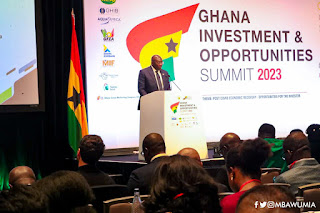
Ghana is back on track with investment opportunities - Veep woos foreign investors

Accra, June 6, GNA-Vice President Mahamudu Bawumia says Ghana's economic opportunities for private sector investors are back on track as...