A newsroom, bedeviled by missed deadlines, a short-handed copy desk and a lack of editing candidates, gets creative.
It finds a company that offers editing services. The company is overseas, perhaps in India or Singapore.
Powered by fiber-optic connections that carry data all the way around the world in less than a second, the off-shore company offers a money-back guarantee on deadline performance. In a pinch, it could throw 30 editors at an edition, three times as many as the newspaper could ever afford to deploy in its own office.
The quality is good. Hundreds of thousands of people in India grow up in English-speaking schools, and they're working hard to build careers. The work is cheap by U.S. standards. The rate is a third less than what the American newspaper is paying. There are no health benefits, vacations or sick days, and no utility or equipment costs to the newspaper.
Could it happen? In some respects (though not yet the copy desk), it already has.
The Chicago Tribune is moving the work of 40 circulation customer-contact workers to APAC Customer Service in the Philippines. The newspaper reported that this follows a similar action by its sister, the Los Angeles Times.
The New York Times reported that, in its last months, Knight Ridder considered whether it could consolidate copy editing among widespread papers. It's not that big a leap to move that desk overseas.
Stateside copy editors, traditionally on the right side of supply-and-demand job security, are on the wrong side of offshoring. Some of the safest jobs in the newsroom are becoming the most exportable.
One company, Hi-Tech Export, offers 40 hours of proofreading and copy editing for $295. The company, located in Ahmedabad, India, started in 1992 and did data processing for other Indian companies. It has expanded its offerings and, since 2000, has been developing markets in the United States, Canada, Europe and Australia. Its U.S. office is in Omaha.
Another company, Cicada Media in Bangalore, India, focuses on corporate and marketing communications. It offers to correct errors in grammar, spelling, usage and style, and to proofread. Sound familiar?
At The DallasMorning News recently, as people awaited word on buyouts, they griped that their in-house tech questions often were handled by techies in India.
As a recruiter, I frequently get e-mails from people in India offering to work for the Detroit Free Press. Immigration would not be an issue, as they don't plan to move. They are offering, in effect, to be trans-world telecommuters. Their pitches, naive and off-the-mark at first, are getting sharper.
Going in the other direction, U.S. companies are advertising for copy editors now on Monster India, the overseas cousin of the Monster.com job site we know here.
Hi-Tech is not the problem. Nor is Cicada nor Monster nor any company in particular. The problem is that globalization, digitization and tight supply-chain management let all kinds of companies break down jobs, divvy up the parts, ship the components around the world to the best bidders and reassemble them all by deadline. The Newspaper Guild and others have fought offshoring, but protesting won't dent the incentives.
The challenge of segmentation is also the key to survival.How can copy editors -- or any workers -- protect their jobs?
The challenge of segmentation is also the key to survival. Break down the job, analyze the components and take the parts you can do best. New York Times writer Thomas L. Friedman, who laid out scenarios like this in "The World is Flat," differentiates between high-value custom work and "plain vanilla" exportable tasks. The vanilla gets gobbled up first.
The parts of a copy editor's job that would seem most vulnerable to offshoring are also the most mundane: reading proofs and editing calendar listings. How could someone overseas have enough local knowledge to edit calendar listings? The same way someone might adopt an American name and learn a regional U.S. accent to provide more comforting service from a call center 12 time zones away. It can be done.
How about wire stories? How much better are we in my newsroom in Detroit at editing stories from Asia than, say, a person in India? We know our market better, but we are further from the story. Wire stories, which receive a couple of edits before they ever get to us, could be vulnerable to offshoring. Recently, I have seen one newsroom run a shared-content, international-news page that is put together by a nearby neighbor. It works pretty well. And it is not a huge leap to have that page put together 10,000 miles away.
In 1998, an American Journalism Review project on the state of American journalism titled a piece on dwindling foreign reporting as "Goodbye, World." What's next, "Goodbye, Work"?
Anyone with a good job would fight to keep it. Fighting change may be futile. The smarter fight lies in developing the skills required to make yourself not only more essential but more satisfied and competent in the work you want to do.
source : http://www.poynter.org/column.asp?id=83&aid=112040

News from Ghana,the African Sub-Region and More!
13.11.06

Minister lauds NAGRAT decision to call off strike
 Papa Owusu Ankomah, the Minister of Education, Science and Sports, says while the decision by NAGRAT members to call off their strike was a relief to all they must consider constraints of the economy that would not allow the government to meet all their demands.
"I thank them very much for their decision to go back to the classroom but they must know that economic constraints will not allow the government to give them everything they are asking for".
The Minister was addressing an extraordinary meeting of New Patriotic Party (NPP) Polling Station Executives in the Sekondi Constituency at Sekondi on Sunday.
He said the government was dialoguing with NAGRAT leaders on their demand for better conditions of service for their members and that it was wrong to give the government pre-conditions before returning to the classroom.
He said a comprehensive salary structure that would eliminate disparities in salaries of workers was being worked out and advised workers to operate within the ambits of the law and exercise restraint in labour disputes.
Papa Owusu Ankomah dispelled the notion that the government was weak in cases where some individuals or groups were seen to be flouting the laws.
"NPP is a democratic party trying to entrench democracy in the country and will always want the law to take its course".
Papa Ankomah urged party activists to remain loyal, "preach the good news" and work hard to intensify membership drive.
The Minister said the government was on track and had delivered on its promise to revamp the economy and improve all sectors including education and sports to bring improvement in the lives of the people.
He said the introduction of the capitation grant and the school feeding programme in some areas was only to supplement the efforts of parents to educate their wards. Mr. Kwadwo Acquah, the Western regional NPP Organiser, called for strong bonds of unity among members and denounced the activities of some members who vilify and castigate others members of the party and said this tended to damage the image of the party.
"All the sacrifices we gave and the hardship we went through when we were in opposition seems to have been forgotten and some of us are trying to destroy the party's image by their utterances".
Mr. Acquah warned that those whose activities were found to be inimical to the well being of the party would be forced to resign.
GNA
New malaria drug dispensed without serious side effects
 About 1.8 million doses of the new malaria drug, artesunate-amodiaquine, have been dispensed without serious side effects, Dr. Eugene K. Amable of the University of Ghana Medical School, has said.
He was speaking at the scientific session of the just ended 48 annual conference of the Ghana Medical Association (GMA) in Ho under the theme, "Environmental sanitation law and order and health".
Dr Amable said the drug had proved to be 97 percent effective against malaria as against chloroquine's 75 percent.
He said the drug was the first choice drug for the treatment of malaria in 19 African countries.
Dr Amable said the drug was subject to thorough scientific tests and evaluation and was found to be a better choice in terms of efficacy and cost.
He said it was scientifically wrong for the country to continue to depend on chloroquine for the treatment of malaria when its efficacy was assessed to be 75 percent.
GNA
Make assemblies accessible to the people - Minister
Mr Stephen Asamoah-Boateng, the Minister of Local Government, Rural Development and Environment, has urged district assemblies to adopt an open door policy to enable people to have easy access to their services.
He said such a move would not only make people understand the district assembly concept better but also enhance the decentralisation process.
Mr Asamoah-Boateng said this when addressing a public forum to explain government policies and programmes at Konongo in the Asante-Akim North District last Friday.
He said the import of decentralisation process was to bring governance closer to the people hence denying them access to the assemblies would defeat the purpose for which it was introduced.
The minister expressed concern about the bureaucratic nature of most assemblies that he said tended to frustrate people from patronising services being provided by such assemblies.
He noted that rendering service to the public required time as well as patience and charged staff of the various assemblies to render selfless service to the people in order to give true meaning to local governance.
"The time has come for district assemblies to be turned into viable centres for economic growth hence rendering quality services to the people can not be undermined."
He implored district assemblies to strive to be people-centred in their operations since their output would eventually serve as a yardstick to measure the performance of central government.
12.11.06
UNCTAD president Ostenson arrives in Accra
 Mr Olle Ostenson, President of the United Nations Conference on Trade and Development, arrived in Accra Sunday evening to attend a an Africa regional workshop on financing of bio-fuel and jathropa plantation project.
The workshop will take place in Accra on Monday, November 13, 2006.
In an interview with the GNA on arrival at the Kotoka International Airport, Mr Ostenson said bio-fuel usage in West Africa held great prospect for the continent.
He said apart from having the potential of becoming a new export item, it is also an environmental friendly and could generate employment on a massive scale.
Mr Abraham Dwuma Odoom, Deputy Minister for Local Government, met Mr Ostenson on arrival.
GNA
Let’s re-orient Ghanaians on basic hygiene – GMA
 The Ghana Medical Association (GMA) on Sunday called for a serious national re-orientation on basic hygiene and environmental friendly practices right from pre-school through basic education and beyond.
The Association therefore called on health professionals to kick-start the campaign by adopting the education of their clients and communities on basic hygiene, as a key component of their services.
These were contained in a nine-point communiqué issued at the end of the Association’s annual general conference held in Ho. The six-day meeting was under the theme: "Environmental sanitation law and order and health".
The communiqué urged Metropolitan, Municipal and District Assemblies to rigidly enforce their environmental sanitation by-laws.
It entreated the government, “as matter of urgency”, to adequately resource agencies and departments responsible for land management to enable them to enforce laws governing sound environmental practices.
The GMA urged government to liaise with the National House of Chiefs to develop “a more pragmatic and environmentally friendly system of land management”.
The Association tasked the government and related agencies to tackle the illicit drug menace in the country “with all seriousness” and recommended that the Ministry of Health should establish adequately funded units for the rehabilitation of persons suffering from illicit drug use.
It also urged politicians to focus on a common agenda for national development and refrain from polluting the current peace in the country.
The communiqué implored government to seriously consider paying living wages and salaries to public sector workers, “based on exhaustive job description and evaluation,” to ensure equity and fairness in the sector.
GNA
Need for concerted efforts to tackle poverty - CBishops
 The Ghana Catholic Bishops' Conference has stressed the need for concerted efforts to tackle the problem of poverty in the society for Ghana to make progress in socio-economic development. It has therefore called for the evolving of serious programme of industrialization to revive dormant and collapsing industries, strengthen existing ones and establish new ones.
The call was made in a communiqu issued by the Conference at the end of their Annual Plenary Assembly held at Nsuta in the Jasikan Diocese of the Catholic Church from November 4-10.
They reflected on matters concerning the church, the nation and prayed for the people.
The communique called on Government to be proactive in ensuring that the conditions of service for the various professions would enable all Ghanaians experience the minimum comfort needed to exercise their God-given roles in society.
"It is necessary that all hands should be on deck. We must recognise the importance of the profession or skill of every Ghanaian, no matter how mean it may appear."
"We need the doctors, lawyers, religious leaders and teachers just as we need the cleaners, watchmen, farmers, fishermen, drivers, carpenters, electricians and others."
However, the communique said some professions had grave responsibility to society and ?Without their practitioners performing as they should, all the talk about national development and progress based on the rule of law and attainment of prosperity would be a farce.?
The communique encouraged partnership between religious bodies and the State especially in the area of education and noted that religious bodies had a vital role to play in the national development.
It said the partnership between religious bodies and State should be intensified especially in the management of educational institutions that should be reflected in the educational reforms being implemented.
On Ghana's 50th anniversary celebration, the communique noted that ?50 years in the life of any nation and most especially in the life of Africa?s first country south of the Sahara to attain independence is surely an occasion for celebration and a great jubilation at that.'
'The national jubilee should be a year in which the nation takes account of what its citizens? lives have been and resolves to make amends where such changes are called for. It affords the occasion to thank God for what he has enabled the nation to achieve.'
The communique expressed appreciation to God for various blessings bestowed on the nation in the improvement in communication system and rural electrification project and appeal to Government to improve on the road network especially the Hohoe-Yendi road.
It said 'While we decry certain misfortunes of our past political history, we like to note the fundamental goodwill of all governments, past and present in their attempt to achieve the best for all Ghanaians.'
'We also commend the patience with which Ghanaians bore the difficulties and certain violations of human rights with great courage and magnanimity. It is this spirit of patience, tolerance, forgiveness that has contributed to make Ghana an oasis of relative peace in the West African Sun-Region,? it added.
The communique however, expressed concern about the moral decadence in the society born out of the inordinate pursuit of wealth, prestige, honour and false solidarity.
It called on the mass media to be circumspect in their publications and operations and endeavour to avoid activities that would extol evil and vice to the weak-minded in society.
The communique appealed to Ghanaians to work towards lasting peace and tranquillity in the nation in the years ahead.Source:
GNA
Subscribe to:
Comments (Atom)
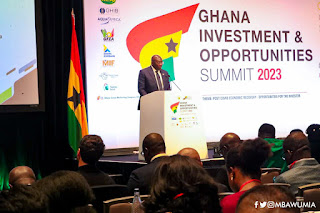
Ghana is back on track with investment opportunities - Veep woos foreign investors
Accra, June 6, GNA-Vice President Mahamudu Bawumia says Ghana's economic opportunities for private sector investors are back on track as...
-
 John E.A Mills died today at a Military Hospital in Ghana. He was 68. He became Ghana's President in 2009 after winning a general ...
 -
 A number of African Heads of State have started arriving in Accra to attend the second conference of the "Partnership with Africa...
 -
 The National Media Commission (NMC) has reconstituted the Board of Directors for State-Owned Media organisations in consultation with Presi...